Once Again I Am Attacked Urinal
| Abu Tahir Sulayman al-Jannabi | |
|---|---|
| Ruler of the Qarmatian country in Bahrayn | |
| Reign | 923–944 |
| Coronation | 923 |
| Predecessor | Abu'l-Qasim Sa'id |
| Successor | Succeeded by his three surviving brothers and nephews |
| Built-in | c. 906 Bahrayn |
| Died | 944 Bahrayn |
Abu Tahir Sulayman al-Jannabi (Arabic: ابو طاهر سلیمان الجنّابي, romanized: Abū Tāhir Sulaymān al-Jannābī , Western farsi: ابوطاهر سلیمانِ گناوهای Abu-Tāher Soleymān-e Genāve'i) was a Persian[1] [2] warlord and the ruler of the Qarmatian state in Bahrayn (Eastern Arabia), who in 930 led the sacking of Mecca.
A younger son of Abu Sa'id al-Jannabi, the founder of the Qarmatian country, Abu Tahir became leader of the state in 923, later on ousting his older brother Abu'50-Qasim Sa'id.[3] He immediately began an expansionist stage, raiding Basra that year. He raided Kufa in 927, defeating an Abbasid army in the procedure, and threatened the Abbasid capital Baghdad in 928 before pillaging much of Republic of iraq when he could not gain entry to the city.[4]
In 930, he led the Qarmatians' most notorious attack when he pillaged Mecca and desecrated Islam'south most sacred sites. Unable to gain entry to the city initially, Abu Tahir chosen upon the correct of all Muslims to enter the city and gave his adjuration that he came in peace. Once inside the metropolis walls the Qarmatian army gear up about massacring the pilgrims, taunting them with verses of the Koran equally they did so.[v] The bodies of the pilgrims were left to rot in the streets.
Early life [edit]
Abu Tahir'south male parent Abu Sa'id was a tribal leader who had initiated the militarization of the Qarmatians.[half dozen] Abu Sa'id began preaching against Sunni Islam effectually 890[vii] after being taught by his mentor Hamdan Qarmat, a native of Kufa, from whose proper name the Qarmatian sect is derived.[7]
Abu Sa'id started off plundering caravans, traders and Persian hajj pilgrims en route to Mecca earlier gathering a big following.[half dozen] The Qarmatians soon mobilized an army and set out to lay siege to Basra. Even so, the governor of Basra learned of their preparations and informed the Abbasid Caliph, al-Muktafi, in Baghdad. The Caliph sent the full general Abbas bin Umar to salvage Basra,[half-dozen] but Abbas was defeated and his men executed and the Qarmatian siege was successful in capturing the city.[6]
Rising to power [edit]
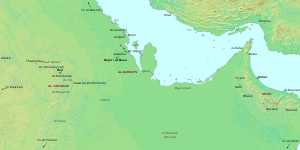
Map of eastern and central Arabia in the ninth–tenth centuries
Most Standard arabic sources concur that Abu Sa'id appointed his oldest son, Abu'l-Qasim Sa'id, every bit his heir, and that Abu Tahir led a revolt against him and usurped his power.[8] Some other tradition, by the Kufan anti-Isma'ili polemicist Abu Abd Allah Muhammad ibn Ali ibn Rizam al-Ta'i, on the other mitt reports that Abu Sa'id always intended for Abu Tahir to succeed him, and had named Sa'id just as regent. According to this view, Sa'id handed over power to his younger blood brother (who was then barely x years old) in 917/918. This report chimes with the story in Ibn Hawqal that Abu Sa'id had instructed his other sons to obey the youngest.[8] Indeed, it is likely that power was nominally invested among all of Abu Sa'id'southward sons, with Abu Tahir being the dominant among them.[nine] Whatsoever the true events, Abu'50-Qasim was not executed, but lived until his death in 972.[eight]
Early reign [edit]
Presently after succeeding al-Muktafi, Caliph al-Muqtadir recaptured Basra and ordered the re-fortification of the city. Abu Tahir successfully laid siege to the urban center one time more, defeating the Abbasid army. After capturing Basra the Qarmatians proceeded to boodle information technology and then withdrew.[6] Abu Tahir returned once more and ravaged information technology totally, destroying the grand mosque and reducing the marketplace to ashes.[6] He ruled Bahrayn successfully during this time and corresponded with local and foreign rulers as far as north Africa, only continued successfully fighting off assaults from the Persians, who were centrolineal with the Caliph in Baghdad.[half-dozen]
Conquests [edit]
Abu Tahir began to frequently raid Muslim pilgrims, reaching as far as the Hijaz region. On i of his raids he succeeded in capturing the Abbasid commander Abu'l-Haija ibn Hamdun. In 926 he led his army deep into Abbasid Iraq, reaching as far north equally Kufa, forcing the Abbasids to pay large sums of coin in for him to leave the city in peace. On his way habitation he ravaged the outskirts of Kufa anyway.[half dozen] On his render, Abu Tahir began building palaces in the urban center of Ahsa, not simply for himself but for his fellows, and alleged the city his permanent capital.[6] In 928 Caliph al-Muqtadir felt confident plenty to once again confront Abu Tahir, calling in his generals Yusuf ibn Abi'l-Saj from Republic of azerbaijan, Mu'nis al-Muzaffar and Harun.[half dozen] After a heavy battle all were beaten and driven back to Baghdad.[6] Abu Tahir destroyed Jazirah Province as a terminal warning to the Abbasids and returned to Ahsa.[6]
Abu Tahir thought that he had identified the Mahdi as a young Persian prisoner from Isfahan by the name of Abu'l-Fadl al-Isfahani, who claimed to be a descendant of the Sassanid Persian kings.[10] [11] [12] [xiii] [14] Al-Isfahani had been brought back to Bahrayn from the Qarmatians' raid into Iraq in 928.[xv] In 931, Abu Tahir turned over the country to this Mahdi-Caliph, said to in fact be a Zoroastrian revivalist with anti-Arab sentiments. He reinstituted the veneration of fire and engaged in burning of religious books during an eighty-day rule. Isfahani too is thought to have some links with established Zoroastrian orthodoxy as the high priest of the Zoroastrians, Esfandiar Adarbad was executed by the Abbasid Caliph after existence accused of complicity with Abu Tahir.[16] His reign culminated in the execution of members of Bahrayn's notable families, including members of Abu Tahir's family.[17] Abu Tahir's mother conspired to go rid of Abu'l-Fadl; she faked her expiry and sent a messenger to call the Mahdi to resurrect her. When he refused, he was exposed as being a normal man, and Abu Tahir's brother Sa'id killed Abu'50-Fadl later on the Mahdi had reigned for only eight days.[18] Other accounts say fearing for his own life, Abu Tahir announced that he had been incorrect and denounced the al-Isfahani as a false Mahdi. Begging forgiveness from the other notables, Abu Tahir had him executed.[19]
Invasion of Mecca [edit]
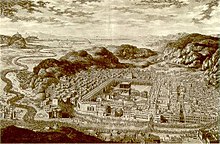
Abu Tahir desecrated Islam'southward holiest site afterward gaining entry (Mecca circa 1778)
Before Abu Tahrir's rule, the Qarmatians had launched several raids along the pilgrim routes crossing Arabia. In 906, Qarmatians ambushed the pilgrim caravan returning from Mecca and massacred 20,000 pilgrims.[xx] During the Hajj of 930 CE, Abu Tahir led the Qarmatians' most infamous attack when he pillaged Mecca and desecrated Islam'south most sacred sites. Unable to gain entry to the city initially, he called upon the right of all Muslims to enter the city and gave his adjuration that he came in peace. Once inside the city walls the Qarmatian ground forces set almost massacring the pilgrims, riding their horses into Masjid al-Haram and charging the praying pilgrims. While killing pilgrims, he taunted them with verses of the Koran[5] and verses of poetry: "I am past God, and by God I am ... he creates creation, and I destroy them".
The attack on Mecca symbolized the Qarmatians' pause with the Islamic world; information technology was believed to have been aimed to prompt the appearance of the Mahdi who would bring about the final cycle of the globe and end the era of Islam.[19]
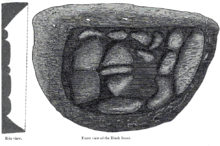
The fragmented Blackness Stone as information technology appeared in the 1850s, forepart and side illustrations
The Qarmatians defiled the Zamzam Well with the bodies of pilgrims and the Blackness Rock at the Kaaba was struck and smashed past a rock fired from a catapult,[21] it was smeared with excrement, and afterwards smashed into several fragments.[22] It was stolen and taken to the oasis in Eastern Arabia known as al-Aḥsāʾ, where information technology remained until the Abbasids ransomed it in 952 CE. According to historian al-Juwayni, the stone was returned 22 years later on in 951 nether mysterious circumstances. Wrapped in a sack, information technology was thrown into the Great Mosque of Kufa in Iraq, accompanied by a note saying "By command we took it, and by command we take brought information technology back." The theft and removal of the Black Stone acquired it to break into seven pieces.[23] [24] [25] the basic shape and structure of the Kaaba have not inverse since then[26] [27]
The sack of Mecca followed millenarian excitement amidst the Qarmatians (and in Persia) over the conjunction of Saturn and Jupiter in 928. Bahrain became the seat of the Qarmatian Mahdi-Caliph from Isfahan who abolished Sharīa police. The new Mahdi also changed the qibla of prayer from Mecca to that of fire, a specifically Zoroastrian practise. Some scholars accept the view that "they may non accept been Isamailis at all at the outset, and their acquit and customs gave plausibility to the belief that they were not simply heretics but bitter enemies of Islam."[28] [29]
Concluding years and death [edit]
Abu Tahir resumed the reins of the Qarmatian state and once again began attacks on pilgrims crossing Arabia. Attempts by the Abbasids and Fatimids to persuade him to return the Black Stone were rejected.
He died in 944 effectually the age of 38, due to smallpox.[30] He was succeeded by his three surviving sons and nephews.[31]
Come across also [edit]
- History of Bahrain
- 1979 Grand Mosque seizure
References [edit]
- ^ Carra de Vaux & Hodgson 1965, p. 452.
- ^ Madelung, Wilferd (1983). "ABŪ SAʿĪD JANNĀBĪ". In Yarshater, Ehsan (ed.). Encyclopædia Iranica, Volume I/four: Abū Manṣūr Heravı̄–Adat. London and New York: Routledge & Kegan Paul. pp. 380–381. ISBN 978-0-71009-093-v
- ^ Daftary 1990, p. 160.
- ^ Halm 1996, p. 255.
- ^ a b Halm 1996, pp. 255 f..
- ^ a b c d e f m h i j thousand l Akbar Shah Khan Najibabadi (2001). Salafi, Muhammad Tahir (ed.). The History of Islam. Vol. 2. Darussalam. ISBN978-9960-892-93-1.
- ^ a b Wynbrandt, James (2004). A Brief History of Kingdom of saudi arabia. Infobase Publishing. ISBN978-1-4381-0830-8.
- ^ a b c Madelung 1996, p. 37.
- ^ Madelung 1996, p. 39.
- ^ Imagining the End: Visions of Apocalypse Past Abbas Amanat, Magnus Thorkell - Folio 123
- ^ Women and the Fatimids in the Globe of Islam - Page 26 by Delia Cortese, Simonetta Calderini
- ^ Early Philosophical Shiism: The Ismaili Neoplatonism of Abū Yaʻqūb Al-Sijistānī - Folio 161 by Paul Ernest Walke
- ^ The Other God: Dualist Religions from Artifact to the Cathar Heresy by Yuri Stoyanov
- ^ Classical Islam: A History, 600–1258 - Folio 113 by Gustave Edmund Von Grunebaum
- ^ Halm 1996, p. 257.
- ^ "CARMATIANS – Encyclopaedia Iranica". iranicaonline.org . Retrieved 2020-10-28 .
- ^ Farhad Daftary, The Assassin Legends: Myths of the Isma'ilis, IB Tauris, 1994, p21
- ^ Delia Cortese; Simonetta Calderini (2006). Women and the Fatimids in the Earth of Islam. Edinburgh University Press. pp. 26–. ISBN978-0-7486-1733-3.
- ^ a b Daftary 1990, p. 162.
- ^ John Joseph Saunders, p. 130.
- ^ Topkapı Sarayı Müzesi. Hırka-i Saadet Dairesi (2004). The sacred trusts : Pavilion of the Sacred Relics, Topkapı Palace Museum, Istanbul. Hilmi Aydın, Talha Uğurluel, Ahmet Doğru. Somerset, N.J.: Light. ISBN1-932099-72-vii. OCLC 56942620.
- ^ Burton, Richard Francis (2009). Personal Narrative of a Pilgrimage to El-Medinah and Meccah. Cambridge: Cambridge Academy Press. doi:10.1017/cbo9781139162302. hdl:2027/coo.31924062544543. ISBN978-ane-139-16230-two.
- ^ "Qarmatiyyah". Overview of World Religions. St. Martin's Higher. Archived from the original on 2007-04-28.
- ^ Cyril Glasse, New Encyclopedia of Islam, p. 245. Rowman Altamira, 2001. ISBN 0-7591-0190-6
- ^ "Black Stone of Mecca". 'Encyclopædia Britannica'
- ^ Javed Ahmad Ghamidi. 'The Rituals of Hajj and 'Umrah Archived 7 March 2010 at the Wayback Machine, Mizan, Al-Mawrid
- ^ Peters, F. E. (1994). Mecca : a literary history of the Muslim Holy Land. Mazal Holocaust Collection. Princeton, North.J.: Princeton Academy Press. ISBN0-691-03267-10. OCLC 30671443.
- ^ John Joseph Saunders, A History of Medieval Islam, Routledge 1978 p130
- ^ Syed, Muzaffar Husain; Akhtar, Syed Saud; Usmani, B. D. (2011-09-14). Concise History of Islam. Vij Books India Pvt Ltd. ISBN978-93-82573-47-0.
- ^ Carra de Vaux, B. & Hodgson, G. G. S. (1965). "al-D̲j̲annābī, Abū Saʿīd Ḥasan b. Bahrām". In Lewis, B.; Pellat, Ch. & Schacht, J. (eds.). The Encyclopaedia of Islam, New Edition, Volume II: C–G. Leiden: East. J. Brill. p. 453. OCLC 495469475.
- ^ Halm 1996, p. 383.
Sources [edit]
- Canard, Chiliad. (1965). "al-D̲j̲annābī, Abū Ṭāhir". In Lewis, B.; Pellat, Ch. & Schacht, J. (eds.). The Encyclopaedia of Islam, New Edition, Book II: C–G. Leiden: E. J. Brill. pp. 452–454. OCLC 495469475.
- Carra de Vaux, B. & Hodgson, Grand. K. Due south. (1965). "al-D̲j̲annābī, Abū Saʿīd Ḥasan b. Bahrām". In Lewis, B.; Pellat, Ch. & Schacht, J. (eds.). The Encyclopaedia of Islam, New Edition, Volume II: C–1000. Leiden: East. J. Brill. p. 452. OCLC 495469475.
- Daftary, Farhad (1995). The Assassinator Legends Myths of the Isma'ilis. Bloomsbury Academic. ISBN9781850439509 . Retrieved 26 October 2021.
- Daftary, Farhad (1990). The Ismāʿı̄lı̄s: Their History and Doctrines. Cambridge: Cambridge University Press. ISBN978-0-521-37019-six.
- Madelung, Wilferd (1996). "The Fatimids and the Qarmatīs of Bahrayn". In Daftary, Farhad (ed.). Mediaeval Isma'ili History and Thought. Cambridge Academy Press. pp. 21–73. ISBN978-0-521-00310-0.
- Halm, Heinz (1996). The Empire of the Mahdi: The Rise of the Fatimids. Brill. ISBN978-90-04-10056-five.
Source: https://en.wikipedia.org/wiki/Abu_Tahir_al-Jannabi
0 Response to "Once Again I Am Attacked Urinal"
Post a Comment