Google - Google Wifi Ac1200 Dual-band Mesh Wi-fi System Review
Almost a year ago, I revisited the Google WiFi review and I came to the conclusion that it could even so be considered one the most all-time dual-band WiFi systems and non much has inverse since so, Google notwithstanding property a larger portion of the incredibly competitive networking market. It's true that Google has released some sort of a successor, the Google Nest WiFi, simply the original mesh systems nonetheless seems to persist in terms of popularity. The first networking product from Google was the Google OnHub (two separate devices, one built by partnering up with TP-Link, the other with Asus), but, despite carrying a large proper noun, these devices did not actually manage to outshine their competitors.
Things have definitely changed for the better after Google entered the wireless mesh system marketplace with its Google WiFi, a device which directly challenged the other mesh systems from Ubiquiti, Luma or Eero in both design and functionality. At the same time, Linksys and Netgear 'intervened' with their own wireless systems (at the prospect of losing influence) and gave united states of america the Velop and the Orbi, both tri-band WiFi systems that managed to deliver a spectacular wireless performance (in that location'southward too the tri-band Eero 2nd generation).
The large advantages that Google had (and still has) was that it's a high-level visitor that could easily outperform its competitors in terms of marketing, but also by using aggressive toll tags. At the same time, Google also faces a big disadvantage that another manufacturers practise not: simply put, people fear that Google may have no restraint on collecting and using their personal data. Similarly to Microsoft and Facebook, Google has become too big and has a history of pushing the boundaries of user privacy, and so information technology does non comes as a surprise that people were a bit skeptical when dealing with any products that come from these big companies.
Update: Considering that about three years accept passed since its release, I decided to revisit the Google WiFi organization and meet if its popularity is still justified in 2020 and if at that place aren't whatsoever other meliorate alternatives available on the market. It's also worth mentioning that the manufacturer has released the Google Nest WiFi which tries to replace the older Google WiFi.
Likewise CHECK OUT: LINKSYS VELOP VS GOOGLE WIFI
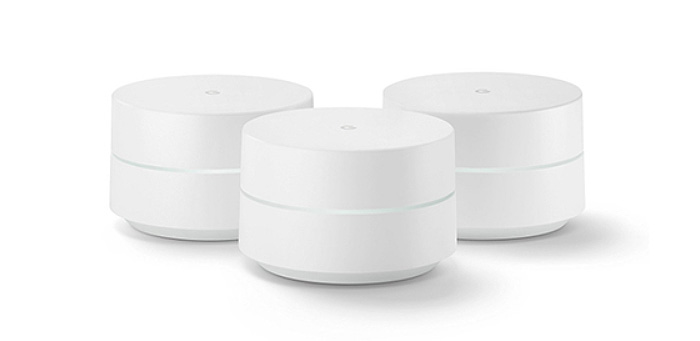
Table of Contents
Design
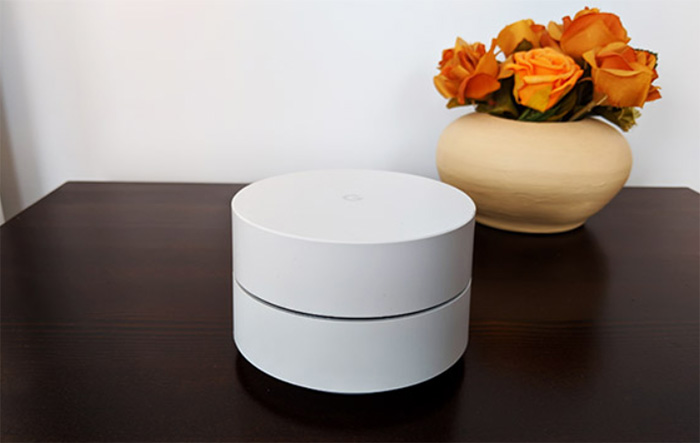
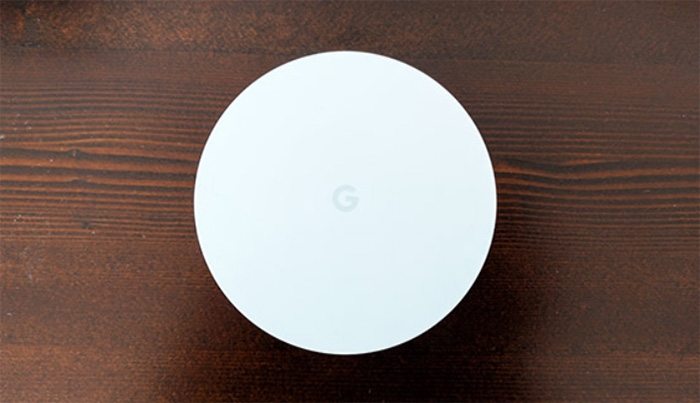
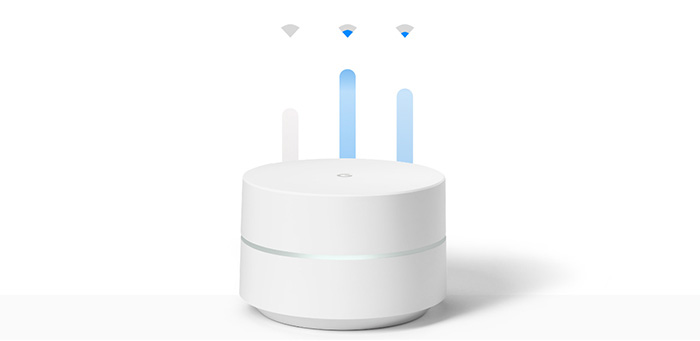
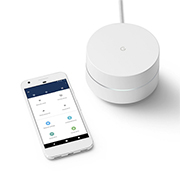
The Google WiFi comes as a single unit or as a three-units kit, all three devices being identical (this is something common with all the other wireless mesh systems). While the Linksys Velop and the Netgear Orbi featured some relatively large, but simple units with a minimalistic arroyo, the Google WiFi took the same route as Eero and Luma and created smaller devices which can be hands placed anywhere in the house. A unmarried Google WiFi router (also called Point) features a small white cylindrical instance, covered past a white matte finish and with a narrow canal halving the body horizontally in ii pieces to make way for the LED indicator.
Every Google WiFi point is well built and feels sturdy, but, surprisingly there aren't many elements to reveal that nosotros're dealing with a networking device. That's correct, the Google WiFi isn't much larger than a face up cream recipient (and you could easily mistake information technology for i), measuring no more than than 4.17 x 2.lxx inches and weighing near 12 ounces. Usually, such a lightweight device would heighten some concerns well-nigh the stability, just, unlike the Linksys Velop and Netgear Orbi, you don't have to worry virtually accidentally hitting any unit of measurement off the table, just considering they're not alpine plenty, so the weight is more distributed.
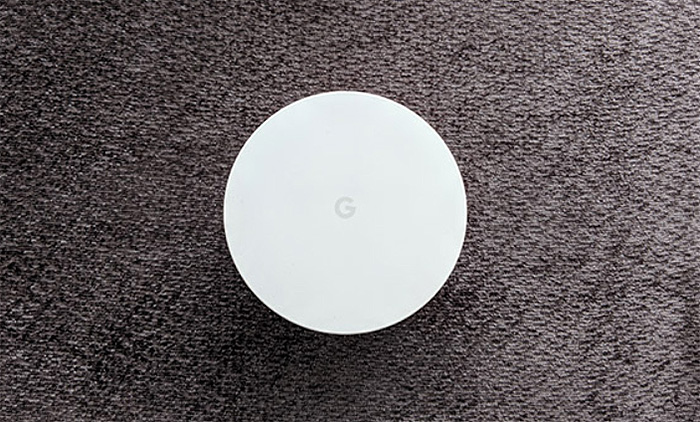
There are some elements (or better said, lack of) that could draw some criticism: I could non find whatever relevant cutting-out or vent holes to indicate a proper airflow, therefore making the Google WiFi routers prone to overheating. Since these type of devices often rely on passive cooling, information technology is very important to permit the estrus to dissipate (ordinarily, through vent grills or holes) and so far, I take noticed that the units get slightly warm while plugged in, simply they didn't overheated and so far (that could change with age).
Because of the nature of the Google WiFi, you can neither mountain it on the wall, nor on the ceiling, simply, y'all exercise get the advantage (that many router do not offer) of being able to position whatever WiFi point anywhere in your home without worrying about infinite or if information technology will fit with the piece of furniture without affecting the overall wait of the room (since these devices are unobtrusive). I won't under-evaluate the aesthetic value of the Eero, Luma, Linksys Velop or Netgear Orbi but, from my point of view, the Google WiFi is the better looking and the most elegant wireless mesh system on the market at this moment (and this remains truthful even in 2020).
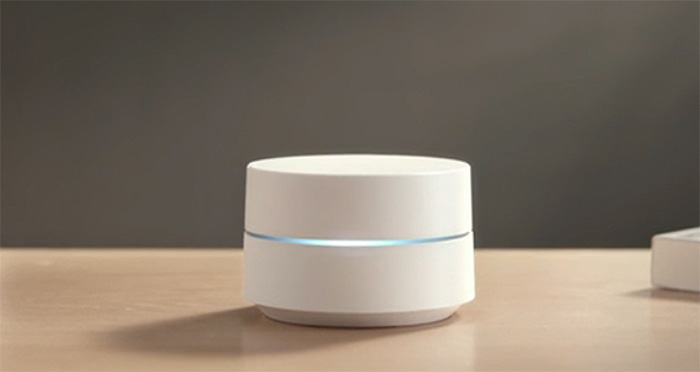
As I mentioned before, cutting through the middle of the case, there's a single narrow LED indicator which shows the status of the network using different colours: if the LED low-cal is solid greenish-bluish, then the WiFi unit is registered and everything works properly, otherwise, if the LED flashes a blueish colour, and then the bespeak is either downloading an update or is ready for setup; if the LED is solid blue, then the system is returning to factory default settings (the process tin can take upward to 5 minutes).
Lastly, if the LED is flashing an amber colour, the WiFi indicate isn't continued to the Internet, otherwise, if the LED is flashing a red color, and so the WiFi bespeak is experiencing an error (if the problem persists, you should contact the manufacturer). Ane of the kickoff routers to have adopted the single LED approach was too created by Google (the OnHub) and, while information technology definitely adds some aesthetic value to the device, I see no existent reward over the traditional assortment of LEDS, since information technology's non an intuitive arrangement and you may need a note with what the colours mean in lodge to really sympathize the electric current system status.
The LED indicator doesn't really become all around the device, the continuity being broken by a elementary white button which has the function of resetting the WiFi betoken to factory default settings (offset, y'all need to unplug the unit of measurement from power, press and hold the button and, while pressing, reconnect the WiFi point to the power source and go along the push button pressed for about x seconds until the LED flashes blueish).
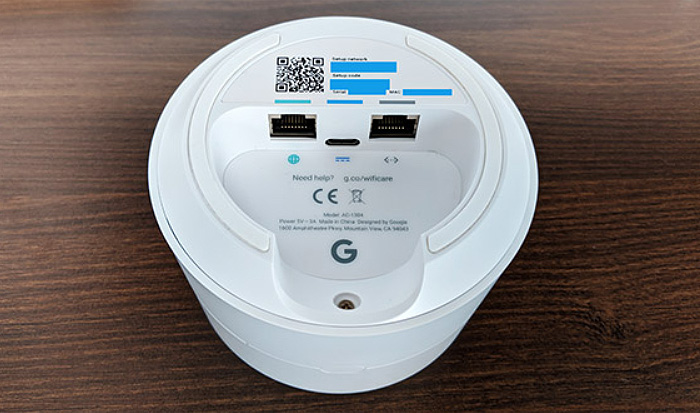
If you plow whatsoever WiFi betoken upside-down, you lot'll notice the ii circular feet that go on the device from budging and a big carved-in area which gives you admission to a couple of Gigabit Ethernet ports (the main WiFi spot volition employ i of the ports to connect to the Cyberspace and the other equally a LAN port; the secondary Google WiFi units volition utilise the 2 ports as LAN ports) and a USB-C port (for powering upward the unit). Too, on the lesser of the device, you tin can find written the Setup network, Setup code, Serial Number and MAC address.
Note: Inside the bundle (for the three pack system), y'all can discover the three WiFi points, 3 power adapters, a Quick Start Guide and a 16.five anxiety Ethernet cablevision.
Internal Hardware
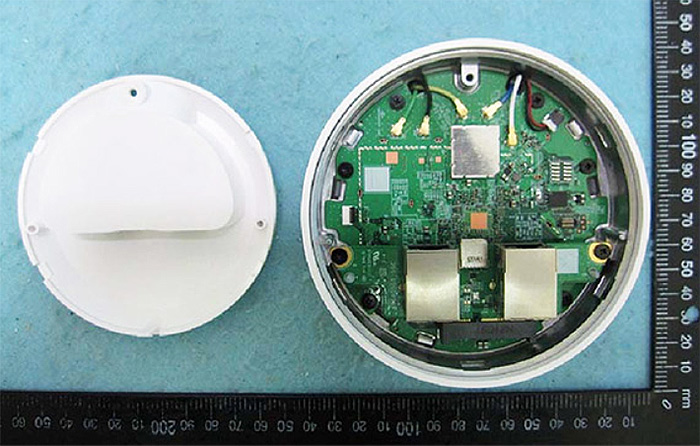
As for the internal hardware, nothing has changed, then, inside every WiFi point, you lot can find a Qualcomm Atheros IPQ4019 chipset (quad-core ARM Cortex-M0 processor), an Infineon Trusted Platform Module STM9615 controller, a Qualcomm Atheros QCA8075 Gigabit Switch, 512MB of RAM and 4GB eMMC wink retentiveness / 4MB Winbond 25Q64FV. Furthermore, the 2.4GHz radio uses the Qualcomm Atheros IPQ4019 chip, along with the Skyworks SKY8530 forepart end module, while the 5GHz radio band too uses the Qualcomm Atheros IPQ4019 chipset, along with a Skyworks SKY85717-xi highly integrated front-end module. The Google WiFi is also equipped with the ZigBee technology (Silicon Labs EM3581 Thread SoC) and with the Bluetooth 4.2 wireless technology standard (part of the CSR102x family).
A unmarried Google WiFi unit is advertised equally beingness function of the AC1200 2×2 Wave 2 Wi-Fi class routers, so, using the ii.4GHz radio ring, the maximum theoretical information transfer is 300 Mbps and, using the 5GHz radio band, the maximum theoretical data transfer is 867 Mbps (the most honest advert and so far, since the other manufacturers normally inflate the number a lot higher even though most other loftier-end wireless systems will likewise behave as AC1200 class routers using the usual devices available on the market).
Features and Wireless Performance
In terms of used technologies, the Google WiFi is less equipped than the Linksys Velop (it lacks some of the latest 2nd wave 802.11ac features), but it does use the wireless mesh capabilities which, similarly to Eero and Luma, should easily cover a larger home with WiFi. Some may wonder what is a wireless mesh organization and in what way is information technology better than a traditional wireless router + extender/southward to encompass up those abrasive WiFi dead spots. First of all, empathize that in gild for a organization to exist called mesh it needs to have more than two units (in this instance, Google WiFi points) with one device continued to the Internet (through a cable modem) and the other unit/southward spread across a larger surface area, each continued to the primary network and each expanding information technology further.
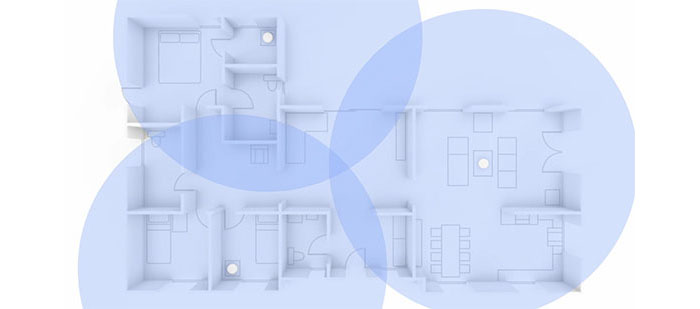
The reward of using a mesh organization is that information technology has some unique backdrop that a traditional system lacks (don't forget that we are still dealing with a proprietary implementation of this tech). First of all, depending on the signal forcefulness, the used channels, the number of connected clients and altitude, each node can connect to any other node in order to search for the best road for the information and to reduce any possible latency. Secondly, one of the most interesting properties is the power to heal the network in case a mesh node (router) goes offline by re-scanning whatsoever nearby nodes and re-routing the data through the all-time possible path and so you lot won't experience any reanimation or disconnects.
Furthermore, with every added node, the organization expands the network and it changes the electric current routes into better ones for the sent and received information (the not-proprietary technology could also add more than than i Net sources to a single network). All these are the primary advantages, but in that location are also some disadvantages and the virtually important of all are the latency and the backhaul traffic treatment. This problem gets a lot clearer when we're dealing with one-radio systems, where, as you add together an extender, you get less bandwidth for data transfer because a large portion has to be kept for the backhaul traffic.
The Google WiFi has the reward of using two radio bands for both the mesh-backhaul traffic and the clients, but it does suffer from the same issue as you add more clients and more nodes. Of class, a tri-band approach with a dedicated radio is the all-time solution so far. The best tri-band WiFi systems to utilise a dedicated radio for backhaul are Netgear Orbi and the Zyxel Multy X, the former being able to outperform nigh, if non all other systems. Unfortunately, the Netgear Orbi will not provide the advantages of a mesh organisation, since information technology uses a chief router unit + satellite extenders setup instead (merely it is a good alternative to keep in mind).
Similarly to the Velop, the Google WiFi radio'due south bandwidth is existence shared past the backhaul traffic and past the clients, but since it'southward not a tri-ring organisation, the wireless functioning tin endure a fleck. One approach that tin exist used by both the Google WiFi and by the Velop to maintain a more than stable and loftier performing system is the Ethernet backhaul. Of course, this pretty much negates the purpose of this production, but, if you aren't bothered past cables running in your home, y'all will get more bandwidth for your clients and it allows more than Google WiFi points to be added to the network.
The features that set autonomously some of the newer wireless systems are the tri-band and the MU-MIMO technologies. As we saw before, the Google WiFi is a dual-ring wireless system and it does not seem to take implemented the MU-MIMO engineering. The main reward that this tech can give to the other systems is the ability to serve multiple clients at the same time, instead of letting them compete for the bandwidth (the one-at-a-time approach). The MU-MIMO is used on both the Velop and Orbi equally a way to connect the nodes (and satellites) to each other (or to the main router) and at the same time it allowed devices with compatible wireless adapters to take advantage of this characteristic. Unfortunately, in that location aren't many MU-MIMO uniform devices on the market place (not even in 2020), so right now, it cannot exist used by a large majority of the population (the feature yet being more than exotic than useful).

On the plus side, the Google WiFi uses automatic band steering, and so devices are automatically moved between the 2.4 and the 5GHz networks (based on the signal strength, bandwidth available and other filters) and it likewise uses client steering, which ways that devices are automatically assigned to the best nearby node (this ensures for a seamless transition when moving around the house). For these ii features to office properly, Google has made it mandatory that the ii radio bands can't be separated (y'all will have but i network).
Google WiFi
Pros
- Great Design
- Very Easy To Setup
- Stable Wireless Performance
- Tin Create A Mesh Network
- It Has A Competitive Price
Cons
- Lacks Some Important Advanced Features
- No Web Interface
- Only 2 Ethernet Ports per Unit

Marking is a graduate in Information science, having gathered valuable feel over the years working in It equally a programmer. Mark is also the master tech writer for MBReviews.com, covering non only his passion, the networking devices, but too other cool electronic gadgets that you may notice useful for your every day life.
Pages: one ii
Source: https://www.mbreviews.com/google-wifi-system-review/
0 Response to "Google - Google Wifi Ac1200 Dual-band Mesh Wi-fi System Review"
Post a Comment