What Type of Art Was Developed During the Harlem Renaissance
The Harlem Renaissance was a cultural nascence of new ideas and artistic expressions during the 1920s in the Harlem neighborhood in New York City. Information technology consisted of many disciplines like visual arts, music, theatre, and literature. Rooted in the foundations of African American culture, artists sought to take a represent their independence, self-worth, and rightful place in society. Beneath we explore this further and some of the well-known Harlem Renaissance artists.
Table of Contents
- i What Was the Harlem Renaissance?
- 1.i The "New Negro" Movement
- 2 Harlem Renaissance Artwork
- 2.one Works Progress Assistants (WPA) and the Harlem Creative person's Guild
- 3 Major Harlem Renaissance Artists
- 3.1 James Van Der Zee (1886 – 1983)
- 3.2 Augusta Savage (1892 – 1962)
- 3.3 More Harlem Renaissance Artists
- iv The African American Legacy
- v Oftentimes Asked Questions
- 5.1 When Was the Harlem Renaissance?
- v.2 How Did the Harlem Renaissance Starting time?
- 5.3 What Was the Harlem Renaissance?
- v.four What Was Harlem Renaissance Art?
- 5.v What Were the Characteristics of Harlem Renaissance Art?
- v.vi What Did Harlem Renaissance Artists Express Through Sculpture?
What Was the Harlem Renaissance?
When we wait at the Harlem Renaissance timeline, we volition come across that it started during the belatedly 1910s and early on 1920s in New York Urban center, around the end of Globe State of war I. It lasted until the 1940s, around the time of World State of war II. Notwithstanding, some sources indicate that it ended around 1929, which was during the time of the Stock Marketplace Crash that led to the Great Depression in 1930. The Harlem Renaissance'due south origins lie in the events leading upwardly to the Great Migration in Southern America around 1916.
Millions of black Americans migrated from places like Mississippi, Due south Carolina, and Louisiana to Northern American cities like New York, Los Angeles, and Washington D.C, among others. This was known as the Corking Migration.
There were many factors that caused Black Americans to drift, primarily the rise and unceasing racial segregations, lynching, and poor social and economic treatment of the African American communities in the South. The Jim Crow laws also negatively affected whatsoever positive chances of betterment for the African American communities.
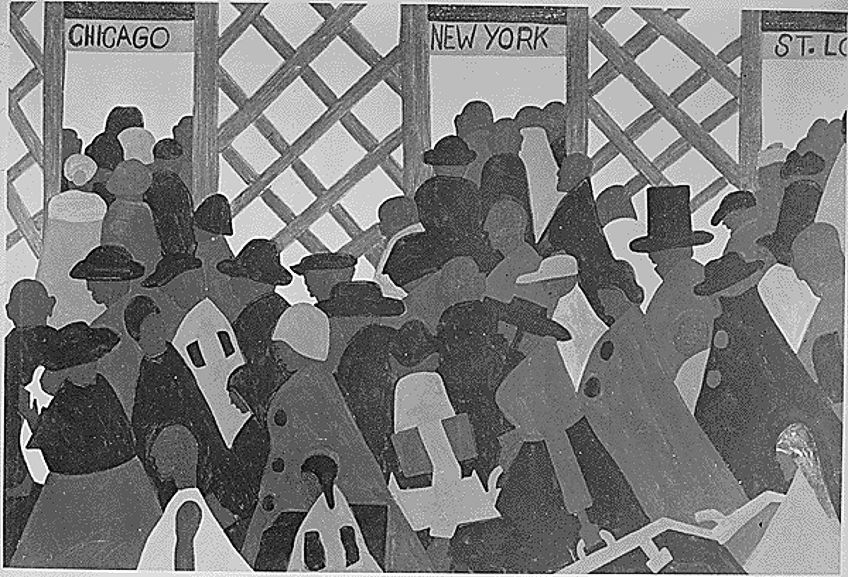 Console 1 from Migration of the Negro (1940-1941) by Jacob Lawrence;Jacob Lawrence (1917 – 2000), Harmon Foundation, Public domain, via Wikimedia Commons
There were also new work opportunities from Northern cities. Many factories and other industries needed workmen because of World War I and the shortage of hands it created. This gave Black Americans the hazard to notice new homes and constitute themselves within the Northern urban areas. Information technology as well led to new cultural expressions within these communities.
White communities caused an uproar as a result of the Great Migration, resisting the motion of African American communities to areas farther north. In the Summer of 1919, white veterans who had returned dwelling house from the war started attacking the blackness veterans who had also served in the war.
This upshot was called the Ruby Summer.
The attacks took place in various cities, with many African Americans (including women and children) being lynched and killed. Homes and businesses were burnt down and destroyed, and in that location was an overall surge of violence amidst the white communities to eradicate what they believed was a threat to them and the Jim Crow laws.
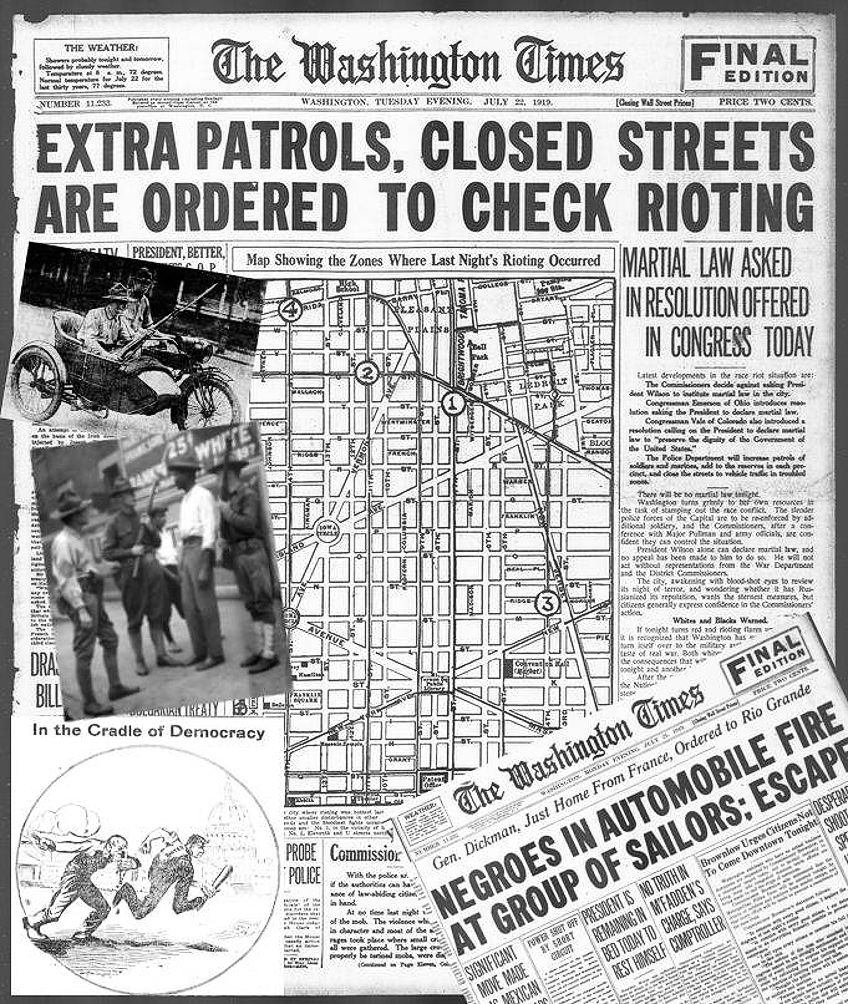 Coverage of the Washington DC race riots, known every bit Carmine Summer, The Washington Times, 1919; The Washington times. July 22, 1919The Washington Times. July 21, 1919, File:Motorcycle involved in the Washington race anarchism of 1919.jpg, File:Richmond planet Newspaper Editorial Cartoon about race riots.jpg, File:Soldiers with Black Resident of Washington, D.C., 1919.png, Public domain, via Wikimedia Commons
When the black veterans who had served in the war returned home, they had a new sense of personal power and agency to stand up against racial injustices. This was undoubtedly regarded as a threat to the racial laws already in place.
The events from the Ruddy Summer compelled many African Americans to stand up in unity as a civilization. This is also read in the poem written past famous Harlem Renaissance author, Claude McKay, titled, If Nosotros Must Die (1919). While the poem does non brand a direct reference to any cultural or racial group, it remains a testament to solidarity.
It was as well considered the starting point of the Harlem Renaissance and its values of justice and equality.
The "New Negro" Motion
Alain LeRoy Locke was born in Philadelphia and was an important writer, philosopher, educator, and fine art patron during the early 1900s. He is well-known for having created the theoretical framework for the Harlem Renaissance and everything information technology stood for. He is ofttimes described equally being the "Dean" of the Harlem Renaissance.
It started when he wrote the article titled Harlem, Mecca of the New Negro (1925) for the Survey Graphic magazine in America. The article was an informative and educational exploration of the African American civilisation based in Harlem.
This article led to Locke producing and co-writing an album with several more essays, fiction pieces, and poems about this burgeoning culture in what was titled The New Negro: An Interpretation. Information technology included the following essays:Forward, The New Negro, Negro Youth Speaks, The Negro Spirituals, and The Legacy of Ancestral Arts.
 Cover of The New Negro: An Interpretation (1925) by Alain Locke; Alain Locke, Public domain, via Wikimedia Commons
Some of the writers who co-wrote with Locke included Claude McKay, Countee Cullen, Eric Walrond, Jean Toomer, Langston Hughes, and Zora Neale Hurston. The abovementioned writers were all multi-talented novelists, playwrights, poets, columnists, and journalists, among others. The anthology was a milestone in the cultural development and evolution of the African American community.
It explored themes based around self and social awareness, identity, solidarity as a community, and the strength inherent in African American people regardless of the atrocities and injustices that they experienced over the decades.The New Negro also expanded on the concepts of "Old Negro" and "New Negro", exploring the differences between the two and how the latter had been revived in Harlem. Indeed, the civilization of the "New Negro" went through a rebirth of sorts, hence a Renaissance in Harlem.
This rebirth brought on new forms of self-expression and freedom from slavery, oppression, and the limiting constraints of the Jim Crow laws put in identify.
Locke describes this rebirth as a "spiritual emancipation" and uses the analogy of "shedding the quondam chrysalis". Furthermore, The New Negro was nigh like the manifesto for the Harlem Renaissance movement.
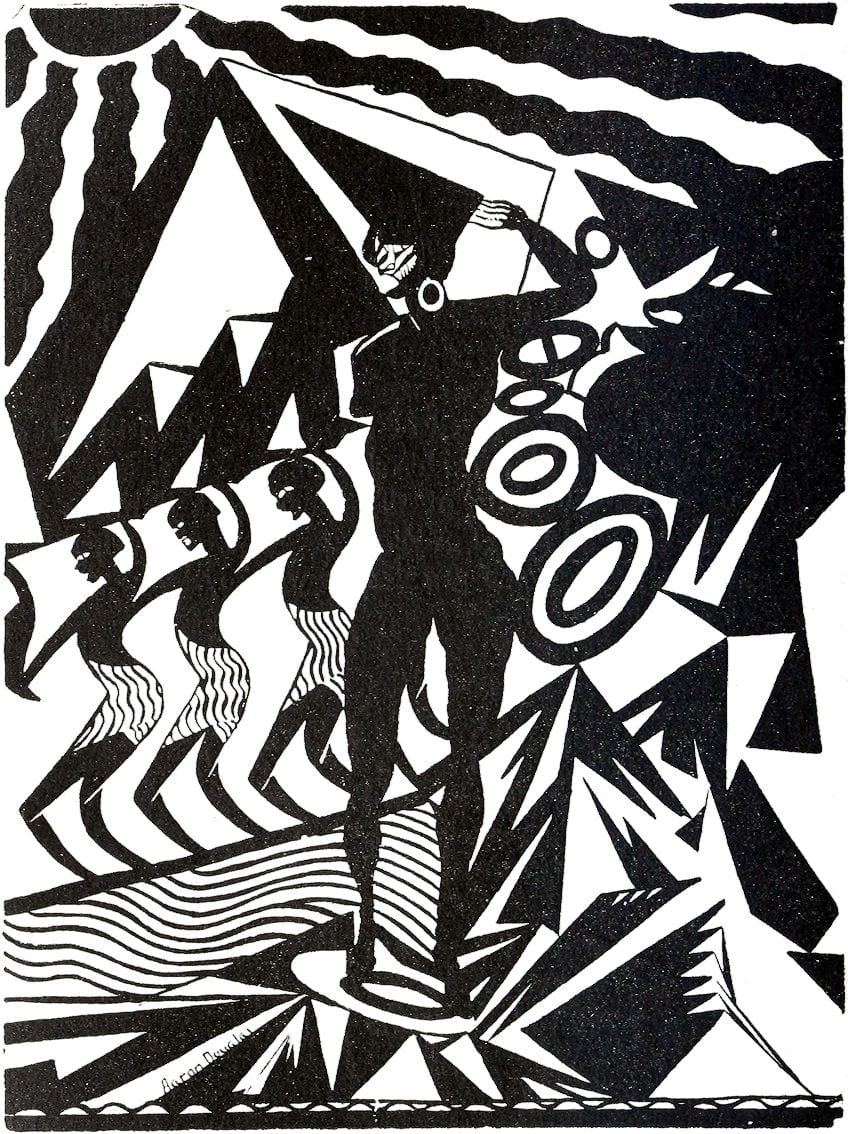 An image by Aaron Douglas from Alain Locke'due south The New Negro: An Interpretation (1925);By Alain Locke, Public Domain, Link
Before Locke'due south introduction of The New Negro, in that location were of import figures within the African American community who had laid the foundations of discourse on oppression and racism in African American communities. Some of these figures include Booker T. Washington and Hubert H. Harrison.
West.E.B. Du Bois was also an important figure, being an activist, socialist, and author. His main contributions were in the Ceremonious Rights movements and acting against the racial oppressions from Jim Crow laws and lynching, and he sought to educate all about African independence and equality.
Harlem Renaissance Artwork
Harlem art stands for all things to practice with the Harlem Renaissance and its expression. Artists expressed themselves in a wide variety of modalities, namely, theater, moving-picture show, poetry, literature, music like Jazz and the Blues, and the visual arts similar painting in the class of murals, sculpture, photography, printmaking, and book illustrations.
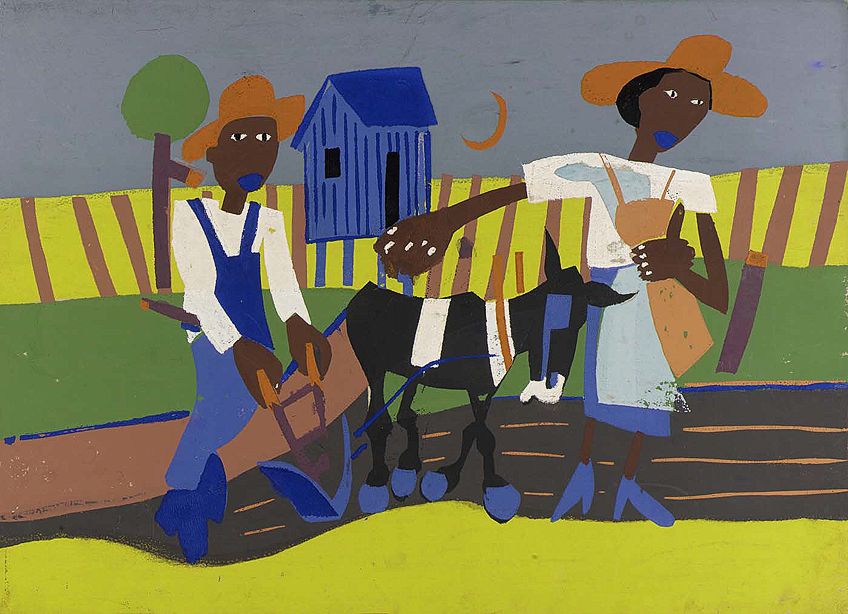 Sowing (1939-1940) past William H. Johnson, screenprint on paper; William H. Johnson, Public domain, via Wikimedia Commons
It was a buzzing cultural awakening in Harlem, and information technology countered and questioned the throes of oppression felt from racism, slavery, and racial injustices, inequalities, and stereotypical perspectives. This cultural enkindling was given life through the visual arts. Decades afterward, nosotros still witness the resurgence of a new modern African American life in Harlem.
The Harlem Renaissance artists all participated in an interdisciplinary way, exploring and experimenting with dissimilar themes, influences, and perspectives in their art. It was likewise advanced in its way as artists combined different genres of art, such as, artifact, modernism, realism, and African art.
Works Progress Assistants (WPA) and the Harlem Artist'due south Society
Because the Harlem Renaissance timeline fell forth the same fourth dimension as the Great Depression, many people, including artists, were non able to observe work. The Works Progress Administration (WPA) was founded by President Franklin Delano Roosevelt in the 1930s and provided jobs for unemployed Americans.
One of the projects related to the WPA was the Federal Arts Projection, through which thousands of artists were given financial stipends. The Harlem Renaissance artists were a function of the FAP and produced murals, sculptures, posters, and photographs for many public buildings like libraries, hospitals, theaters, and museums.
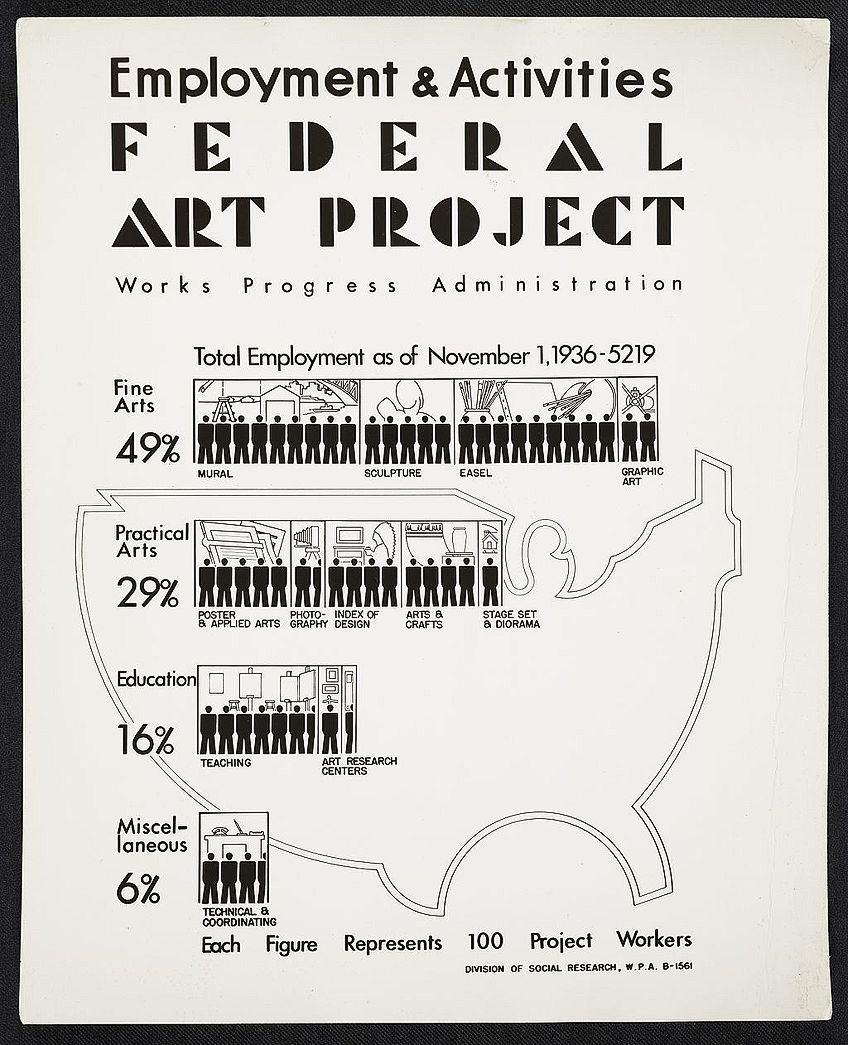 An employment and activities affiche for the WPA's Federal Fine art Project, 1936;Archives of American Fine art, Public domain, via Wikimedia Commons
They were employed, so to say, as artists to uplift public spaces with new artworks. This gave anybody a renewed sense of promise during hard economic times. Many artistic community centers and fine art schools opened to requite artists the opportunities to work.
One of the more famous schools included the Harlem Artist'south Guild, which was co-founded in 1935 past Harlem Renaissance artists Augusta Savage, Charles Alston, and Elba Lightfoot.
This too pushed the Federal Arts Projection to give more opportunities to African American artists. In 1937, the WPA as well funded the new Harlem Community Art Middle, which was created by the Harlem Artist'southward Guild. It is too important to note that Augusta Savage was a leading artist and founder of the Savage School of Arts and Crafts in 1932. She taught many Harlem Renaissance artists and sought to educate and railroad train young artists as well as to cultivate a deeper connection and sense of community within the Harlem fine art civilisation.
Major Harlem Renaissance Artists
While there were hundreds of Harlem Renaissance artists within many disciplines, below we await at some of the famous artists from the time. Some were painters, photographers, and sculptors, among other artistic disciplines.
James Van Der Zee (1886 – 1983)
James Van Der Zee was a photographer during the Harlem Renaissance period, born in Massachusetts. He was well-known for producing visual documentary records of the African American middle classes in New York and their lifestyles. He likewise opened a photography studio chosen the Guarantee Photo Studio.
Some of his photographs include Evening Attire (1922) and Couple in Raccoon Coats (1932), amidst many others. When we expect at Couple in Raccoon Coats as an instance, Van Der Zee photographed an African American couple by their motorcar, which is a Cadillac roadster. The man is sitting in the motorcar while the woman stands next to him.
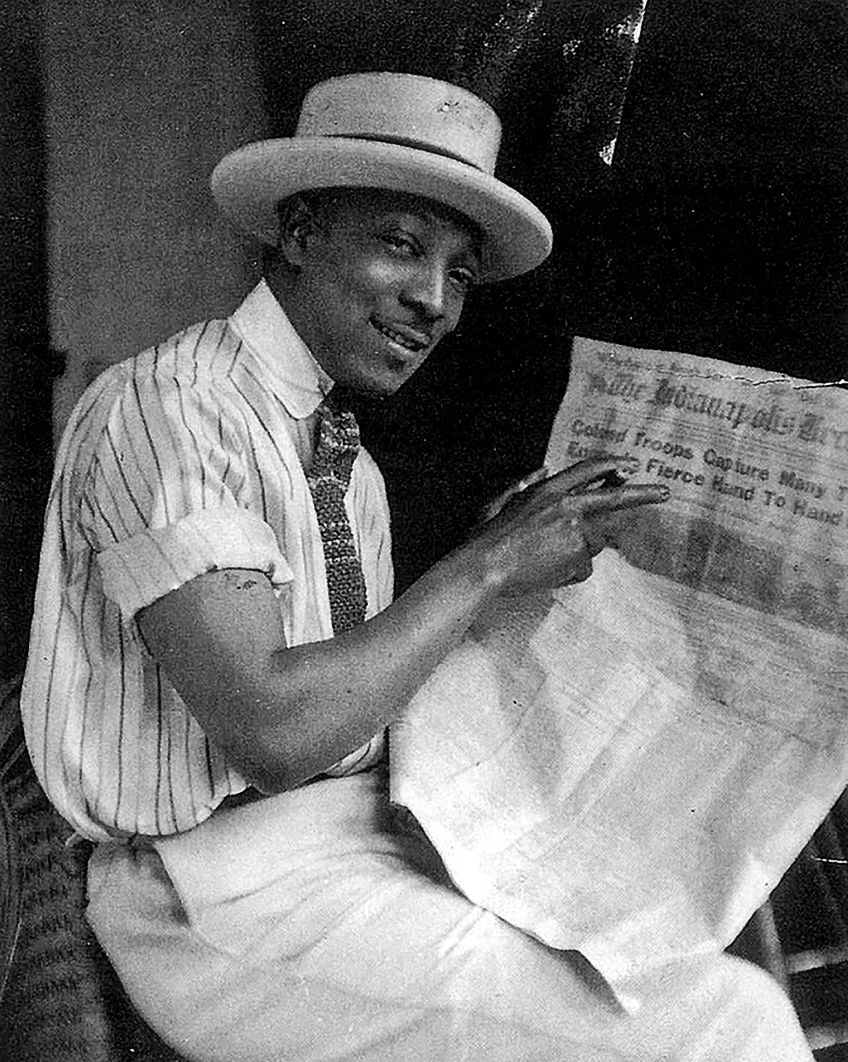 Cocky portrait of James Van Der Zee, taken in 1918; James Van Der Zee, Public domain, via Wikimedia Commons
The couple appears relaxed and stylish, both wearing raccoon coats. Furthermore, Van Der Zee touches on many stereotypes in this photograph and perceptions related to how African Americans lived. The raccoon coat was a prominent fashionable item, especially among the younger generation, but here the artist portrays both the man and woman adorning this item without any worry nigh who should wear it.
Van Der Zee took photographs in a wide variety of settings, such as community-based events, weddings, funerals, and portraits of families. He captured the hearts of many in his photographs, but an important point to remember is that he became an observer during a fourth dimension of not bad change and innovation culturally, racially, and societally.
Augusta Roughshod (1892 – 1962)
Born in Greenish Cove Springs, Florida, Augusta Christine Fells Savage was a prominent sculptor (famous for her portrait sculptors) during the Harlem Renaissance menses. What made her a leading figure within this movement was the fact that she was too an fine art teacher and the fine art director of the community-based Harlem Customs Art Center.
In 1934, as the first African American, she was chosen as part of the National Clan of Women Painters and Sculptors.
Savage also opened her own art school called the Savage Studio of Arts and Crafts. Hither she taught and created opportunities for aspiring artists who were interested in different artistic modalities similar drawing, painting, and sculpting. Many well-known Harlem Renaissance artists emerged from her school, including Jacob Lawrence and Norman Lewis, as well as the notable public effigy in the Civil Rights Movement and children'south educational activity, Kenneth B. Clark, among many others. This fine art school eventually adult into the abovementioned Harlem Community Art Center.
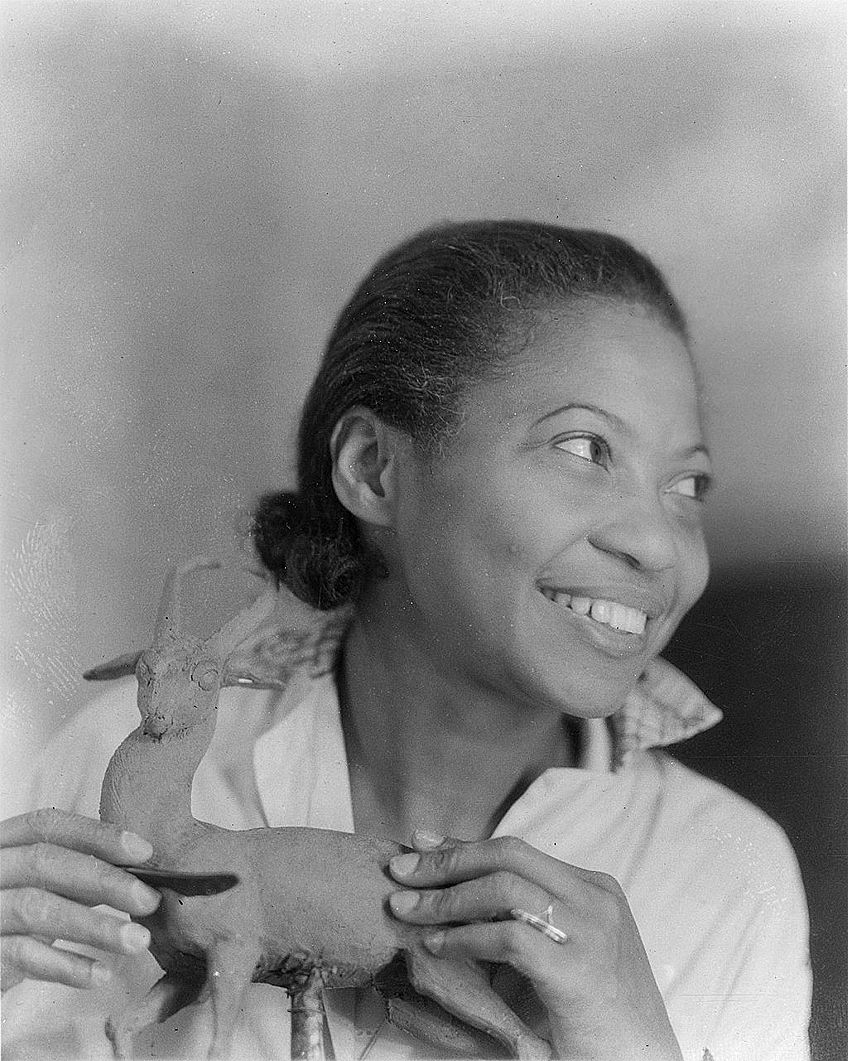 A photograph of Augusta Savage, between 1935 and 1947; Usa Gov., Public domain, via Wikimedia Commons
Some of Vicious'south notable artworks include Gamin (c. 1929), Gwendolyn Knight (1934 to 1935), Harlem Daughter (1935), The Diving Boy (1939), Portrait Head of John Henry (1949), Young Male child (1940 to 1942), and The Harp (originally Elevator Every Vocalization and Sing) (1939).
I of her famous deputed artworks, a 16-foot plaster sculpture, was initially titled Elevator Every Voice and Sing, named after a song by James Weldon Johnson, but it was later retitled to The Harp by the World's Off-white, where it was beingness exhibited.
It depicts 12 elongated African American singers continuing behind the other, each with their arms folded behind their backs.
The figures becoming smaller and smaller, with the concluding four figures held in an open hand. This open manus extends into an arm, which becomes the base to which all 12 figures seem to be fastened. In front end of the 12 singers is a figure of a man kneeling on his right human knee and artillery outstretched in front of him, giving the sense of receptivity and calm surrender. The singing figures behind him appear like a choir and the whole sculpture is in the shape of a harp. Furthermore, the figures are wearing long robes, which fold and autumn into neat, symmetrically elongated lines, giving the impression of harp strings.
This piece was eventually destroyed, and Fell was not able to cast it in bronze. This was a pop sculpture during the Globe'due south Fair and reported to have been function of the most photographed sculptures. It too featured alongside artworks past Salvador Dalí and Willem de Kooning.
Another instance by Savage is Gamin, the bosom of a streetwise boy, which is indicated by the inscription at the base of the bosom. It is reported the boy who modeled for this bust was Barbarous's nephew, Ellis Ford.
This was as well ane of Savage's more famous sculptures, which was emulated further into a life-sized piece and other smaller pieces.
The boy depicted is an African American youth, or gamin, which refers to a boy that frequents the streets, otherwise called a "street urchin". It suggests someone in poverty, which is emphasized by the male child's crinkled shirt and his cap (known as a bebop cap), which was usually worn by young people who worked or dropped off newspapers.
What adds to the emotional intensity of the bust is the tilt of the boy'southward head to the correct. His facial expression is likewise quite subdued and sobering. He does not give the thought of being happy – in fact, he appears unemotional, like someone who has endured hardships and is growing up as well fast.
When we look at Savage'south sculptures, the important question of "what did Harlem Renaissance artists express through sculpture?" is undoubtedly answered by her unique rendering of subject matter closely tied to what was at the heart of Harlem art: expressing the poignant African American journey and culture.
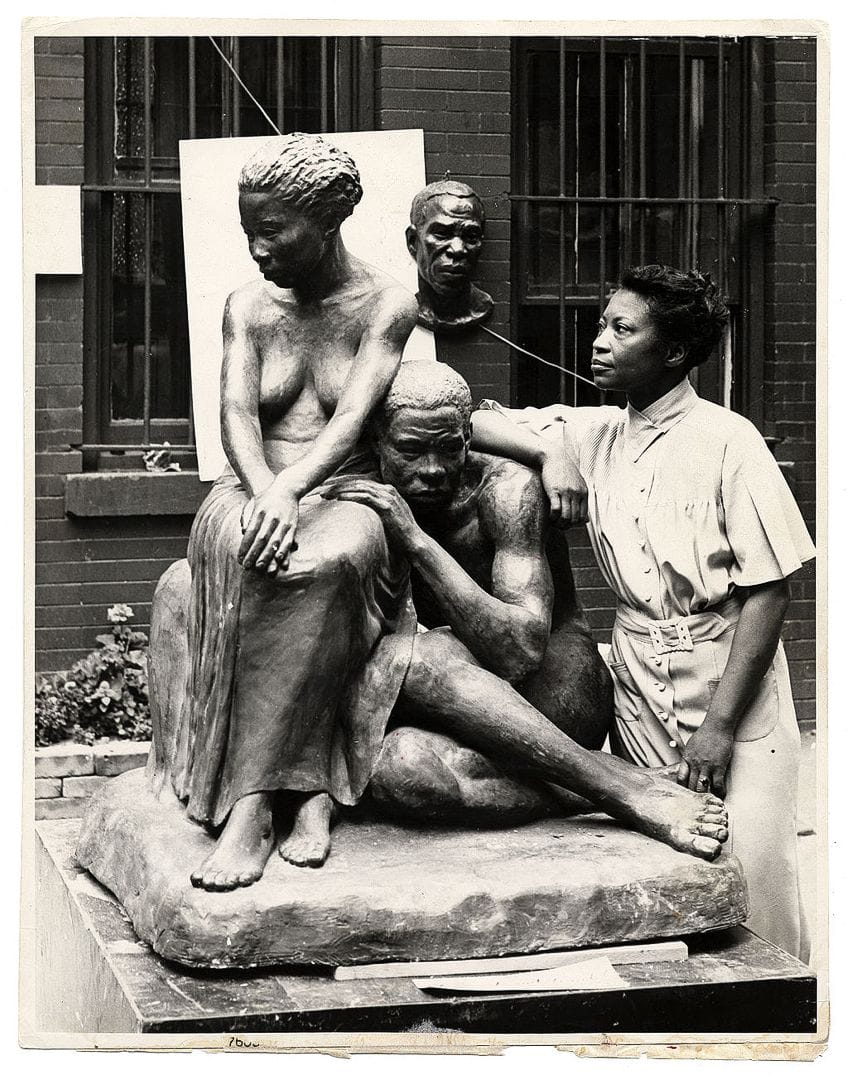 Augusta Savage posing with her sculpture Realization, created equally part of the Works Progress Administration'southward Federal Art Projection, photograph taken by Andrew Herman, c. 1938;Archives of American Fine art, Public domain, via Wikimedia Commons
Aaron Douglas (1899 – 1979)
Built-in in Topeka, Kansas, Aaron Douglas was known as the "Father of African American Art". He was a role of the Harlem Artist's Lodge and was also involved in establishing Fisk University'south Art Department. He inspired and taught many young aspiring artists and was an influential figure in Harlem Renaissance painting.
Some of the characteristics of Aaron's works include African American themes that announced Cubic-like. In fact, the artist was influenced by art movements similar Cubism.
Some of his earlier works were also influenced by modern art movements like Fine art Deco and Fine art Nouveau, such as his slice, Sahdji (Tribal Women) (1925). The artist was also influenced by African fine art, especially West African art and the masks and sculptures from regions like Republic of benin and Senegal.
He used various shapes and circles to inform his compositions, which likewise created an additional dynamism, although in that location was a stylistic two-dimensionality to the overall appearance of the works. His colors were ofttimes more than subdued, and some words that describe his works include "figurative" and "decorative". Some of Douglas' other works include The Judgement Day (1927), Harriet Tubman (1931), The Negro in an African Setting (1934), An Idyll of the Deep South (1934), Disobedience (1972).
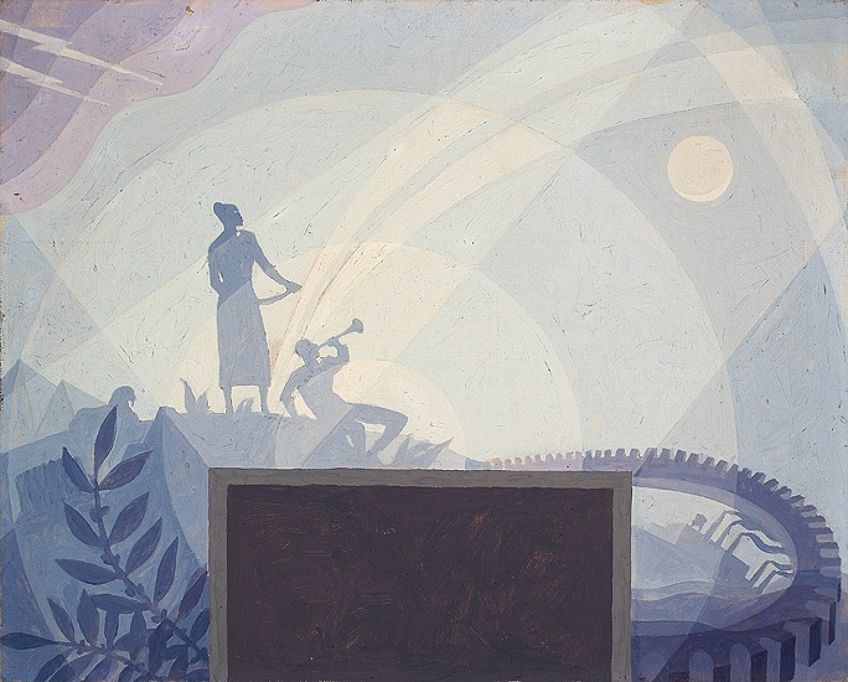 Study for Landscape (1963) past Aaron Douglas;Delaware Fine art Museum, CC BY-SA 3.0, via Wikimedia Commons
When we look at Defiance, one of the creative person's later works, we notice a similarity to his before-mentioned work Sahdji (Tribal Women). Both appear in a feature decorative composition; we see the familiar round and athwart shapes and stylized portrayal of figures. Both compositions also appear blackness and white in the color scheme.
In Sahdji, the central figure is a female. We notice the groundwork (or landscape) depicts geometric pyramidal mountains with a quarter of a sun peeping out of the top left corner of the composition, its streaming rays delineated by thick wavy curls of lines.
In Defiance, the key effigy is a male person, more specifically, Brutus Jones from Eugene O'Neill'southward play Emperor Jones(1920). We detect that the landscape depicts diverse geometric forms of foliage. Furthermore, there is a confrontational feeling in the fashion the Jones character stands with his 2 feet in an extreme version of a duck-footed opinion.
The composition is enlivened by the interaction of different shapes and lines.
We encounter the key figure standing on black wavy lines, suggesting water with two fish taking on both the black and white colors from the palette scheme, as though they were compositional chameleons. Furthermore, the leaf surrounding Jones appears to exist a jungle setting, encroaching on him equally he moves forward. The whip in his correct paw folds over into the foliage behind him and joins with the stylistic patterning of colors from the leaves – again. almost similar a compositional chameleon.
Beauford Delaney (1901 – 1979)
Built-in in Knoxville, Tennessee, Beauford Delaney was a prominent Harlem Renaissance artist, but his piece of work also went aslope that of Abstruse Expressionism. During Delaney'south later on years as an artist, there was influence from the fine art movements Impressionism and Fauvism. He was peculiarly influenced by the works of Vincent van Gogh and focused on depicting the nature of light and color in his compositions.
Delaney lived in Paris in his later years, and equally a Harlem Renaissance artist as well as a gay African American, he was not received as avidly equally other artists. Nonetheless, his piece of work withal left a mark on many later on his death. He was besides seen every bit a courageous human being afterwards having struggled with many challenges.
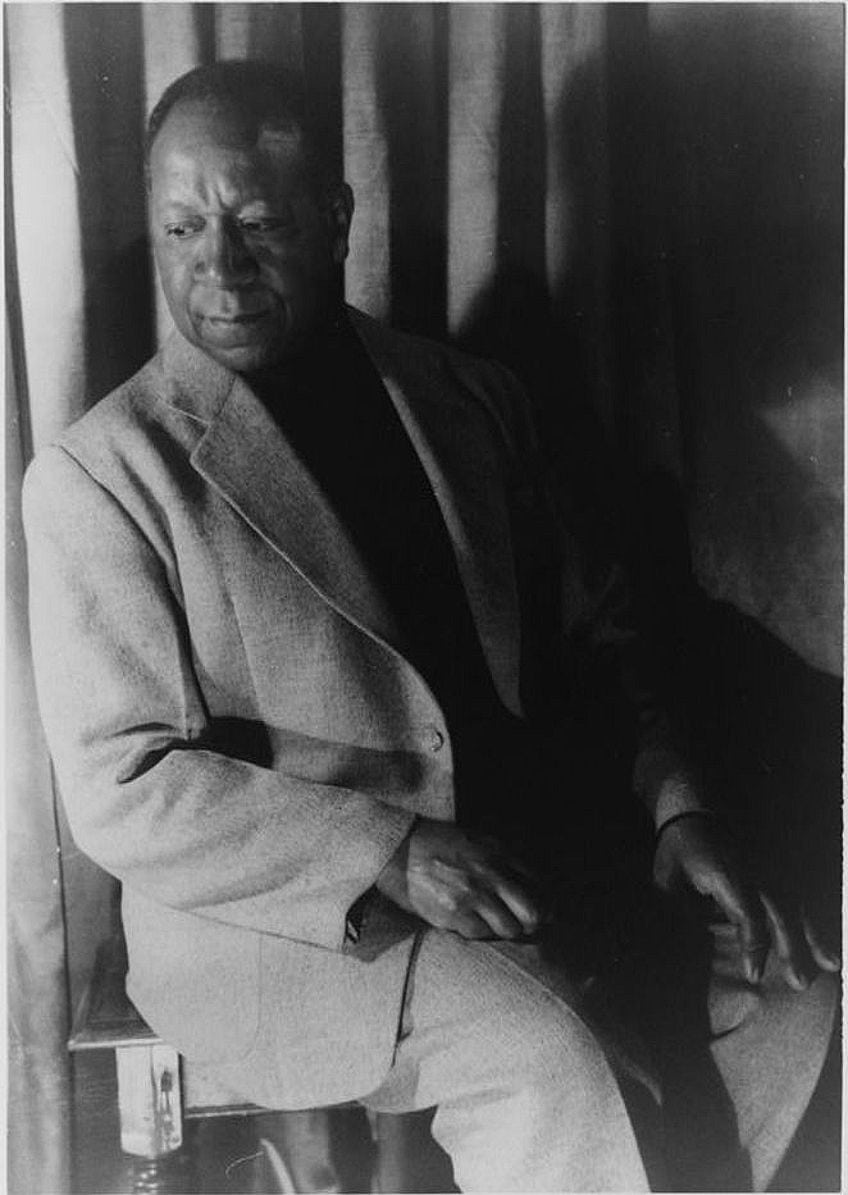 Portrait of American creative person Beauford Delaney (1901–1979) by Carl Van Vechten, 1953; Carl Van Vechten, Public domain, via Wikimedia Eatables
Some of his famous artworks include The Burning Bush (1941), Jazz Quartet (1946), Can Fire in the Park (1946), Portrait of James Baldwin (1955), and the Portrait of Ella Fitzgerald (1968). Delaney'due south piece of work includes a mix between realism and figurative expressions of deeper meanings.
There is also a trend towards the more spiritual aspects in many of Delaney'south works.
For example, in The Burning Bush-league, an earlier work, Delaney incorporates biblical significance with a large literal and figurative fire taking over nearly of the composition, particularly infiltrating the sky. At that place is too a vast expanse of land across the burn down and what appears to exist an ocean.
The colors utilized by Delaney are bawdy in their tones: In the foreground, we meet subdued green, yellowish, orangish, and patches of black, and in the background, we see the light blue and white from the sky. We too observe a thicker application of paint, which gives the composition more than expressive impetus.
William H. Johnson (1901 – 1970)
Born in South Carolina, William Johnson was a painter known for having realism, expressionism, and Folk art as his dominant painting styles. He was also a instructor at the Harlem Community Fine art Center. He produced thousands of artworks like paintings, drawings, watercolors, and prints, which were donated to the Smithsonian American Art Museum.
Some examples of his works include Blind Singer (1941), Going to Church building (1940 to 1941), Street Musicians (1939 to 1940), Sowing (1940), and Three Friends (1944). In the screen print, Blind Vocaliser, we observe two happy musicians: a woman playing the guitar to the correct and a man, who is a blind singer, standing to the left next to her.
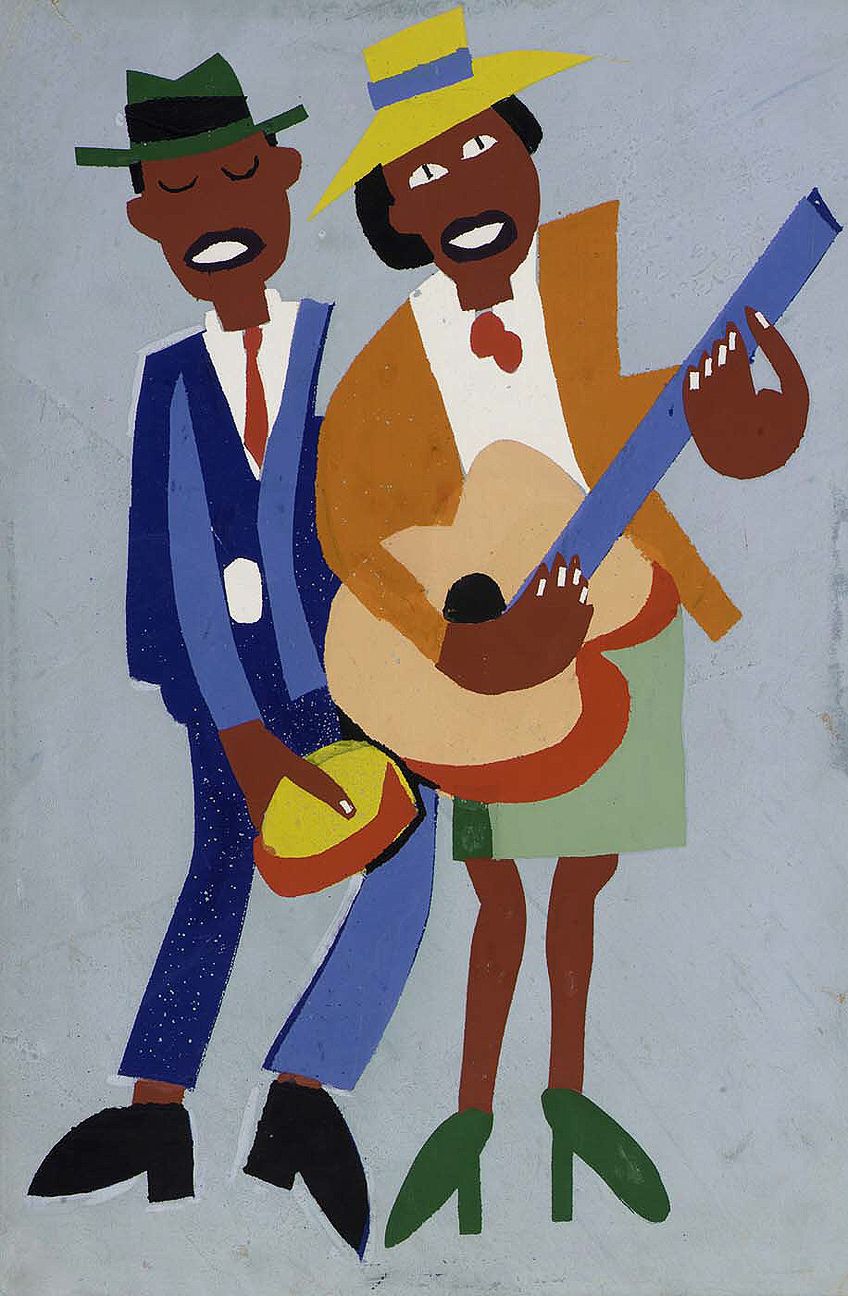 Blind Vocalizer (c. 1939-1940) past William H. Johnson, serigraph on newspaper;William H. Johnson, Public domain, via Wikimedia Commons
Nosotros encounter the feature Folk-fine art style in the composition of the 2 figures. The work is likewise described as having a primitive appearance due to the characteristics of African fine art. There is also an angularity about their forms, which adds a dynamic effect.
Furthermore, there is a simplicity well-nigh their forms and the various shapes surrounding them, such as their shoes and the guitar. Their bodies are also simplified and unrealistic in proportion, which is evident in their legs and enlarged easily, simply this was a part of the creative person'south expressionistic style. For Johnson, screen printing became a dominant class of making art, and in his other works mentioned above, we volition find that his style depicts more simplified forms, showing his interest in the primitive style.
He is quoted as having said, "My aim is to limited in a natural way what I feel, what is in me, both rhythmically and spiritually, all that which in time has been saved up in my family of primitiveness and tradition, and which is now concentrated in me."
Jacob Lawrence (1917 – 2000)
Born in Atlantic Metropolis, New Jersey, Jacob Armstead Lawrence created compositions primarily with the historical subject matter and the everyday experiences of African Americans. His works were likewise characterized by a stylistic print-like quality – the artist intentionally utilized elements from print to include more realistic effects. There are also angular and abstract-like qualities inherent in his figures.
Some of his artworks include diverse series to portray narratives, for example, The Frederick Douglas Serial (1938 to 1939), The Migration of the Negro series (1940 to 1941), and the Hospital Series (1950). Specific examples from these series include Panel 22 from The Migration of the Negro serial and Sedation from the Hospital Series. In Panel 22 we notice three men with their backs facing us, golden handcuffs link them together. They stand with their heads appearing bowed, in a seemingly submissive posture.
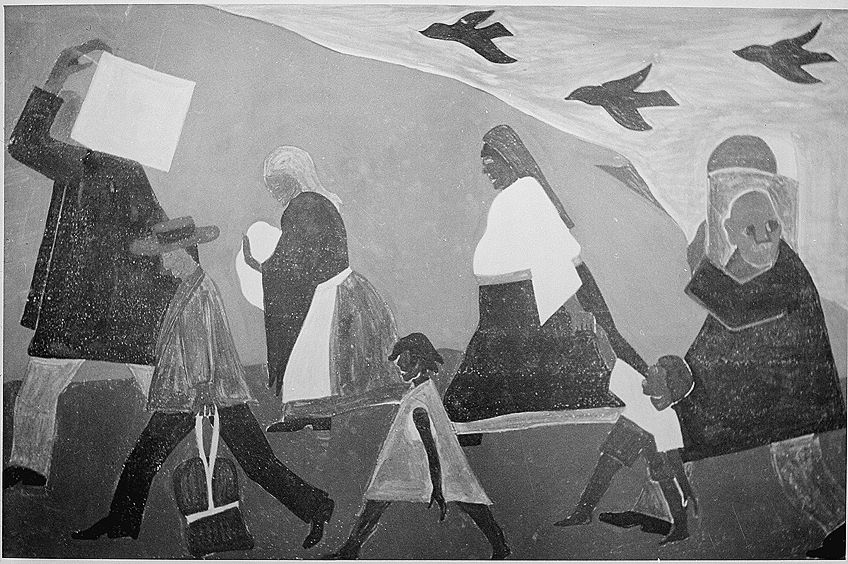 A panel from Jacob Lawrence'south Migration of the Negro series, 1941;National Athenaeum at College Park, Public domain, via Wikimedia Commons
In front of them is a wall with a long row of bars, suggesting that they are in prison. Both this painting and series explore the lives of African Americans during the times they endured enslavement and imprisonment before the Migration era. Stylistically, we notice a subdued monochromatic color palette with a play on the lines in the vertical confined and the vertical stripes on the figure's pants on the right.
The green stripes about break the monotonous color scheme from the rest of the composition.
Sedation shows what appears to be vii figures standing effectually an enclosed space with blue, xanthous, and carmine pills on a white surface, which appears to be a white linen cloth. The figures all look eerily and vacantly at the pills, nigh equally if they are just out of reach, which is causing them to announced fifty-fifty more downtrodden.
The way Lawrence depicted the figures too emphasizes the eeriness of the stark reality of beingness in a mental establishment and being a patient within. The figures all appear clad in their pajamas and robes, standing closely next to ane another with no spaces between them, which further emphasizes a sense of anxiousness to get to the pills in front end of them.
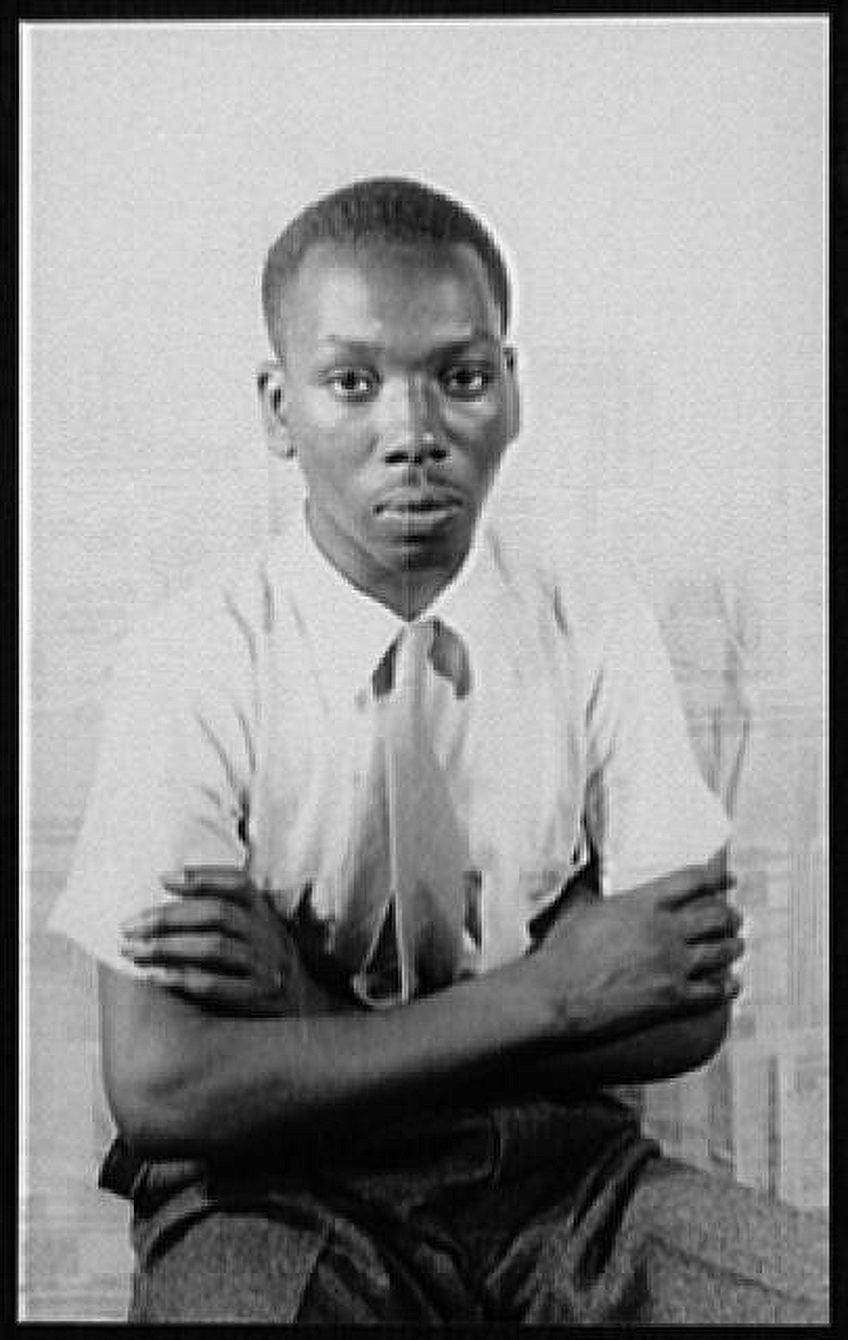 Portrait of Jacob Lawrence, 1941;Carl Van Vechten, Public domain, via Wikimedia Commons
Lawrence depicted the figures in subdued colors, where the color palette consists mostly of off-greens and some brighter blues in-between. The background appears kaleidoscopic in its use of geometric blueish, yellow, black, and greyness-brown shapes.
The composition shows an intermingling of a somewhat depressing and clashing spectrum of shapes and colors – a direct portrayal of what it must feel like being in the state we see portrayed past the figures.
The artist had first-hand experience of what it was like in a psychiatric ward as he admitted himself for a twelvemonth in the Hillside Hospital located in Queens. This specific piece was done to explore the ofttimes ambiguous relationship between mentally ill patients and their intake of medication, and whether it is the medication that entraps them further in the mental establishment.
This Harlem Renaissance painting was markedly different from Lawrence's other paintings, which depicted figures related with historical significance. The figures in this series are without hope and resigned to their fates. The artists likewise delved strongly into the recesses of psychological issues. Other notable works past Jacob Lawrence include This is Harlem (1943), Victory (1947), 2 Rebels (1963), and The Builders (1980).
More Harlem Renaissance Artists
While the above-mentioned list of Harlem Renaissance artists includes of import figures of the time, there were many more than talented artists from unlike disciplines who created non simply paintings, but photographs, sculptures, films, and written works.
Some of the other artists worth mentioning are Archibald John Motley Jr., Loïs Mailou Jones, Richmond Barthé, and Langston Hughes, the latter of whom was a famous Harlem Renaissance poet and co-founder of the Burn!! Mag, a Harlem Renaissance publication.
Other well-known photographers were James Latimer Allen, Roy DeCarava, and Oscar Micheaux, who was a motion picture director and producer, having created Homesteader (1919) and Within Our Gates (1920) among more than forty other films.
Other artists include Meta Vaux Warrick Fuller, who was an early on Harlem Renaissance artist. Her extensive studies in Paris led her to meet West.E.B. Du Bois and the well-known sculptor, Auguste Rodin, who mentored her in creating sculptures with inherent realism. She also incorporated an Egyptian mode in her sculptures. Some of her famous works include Ethiopia Awakening (1921).
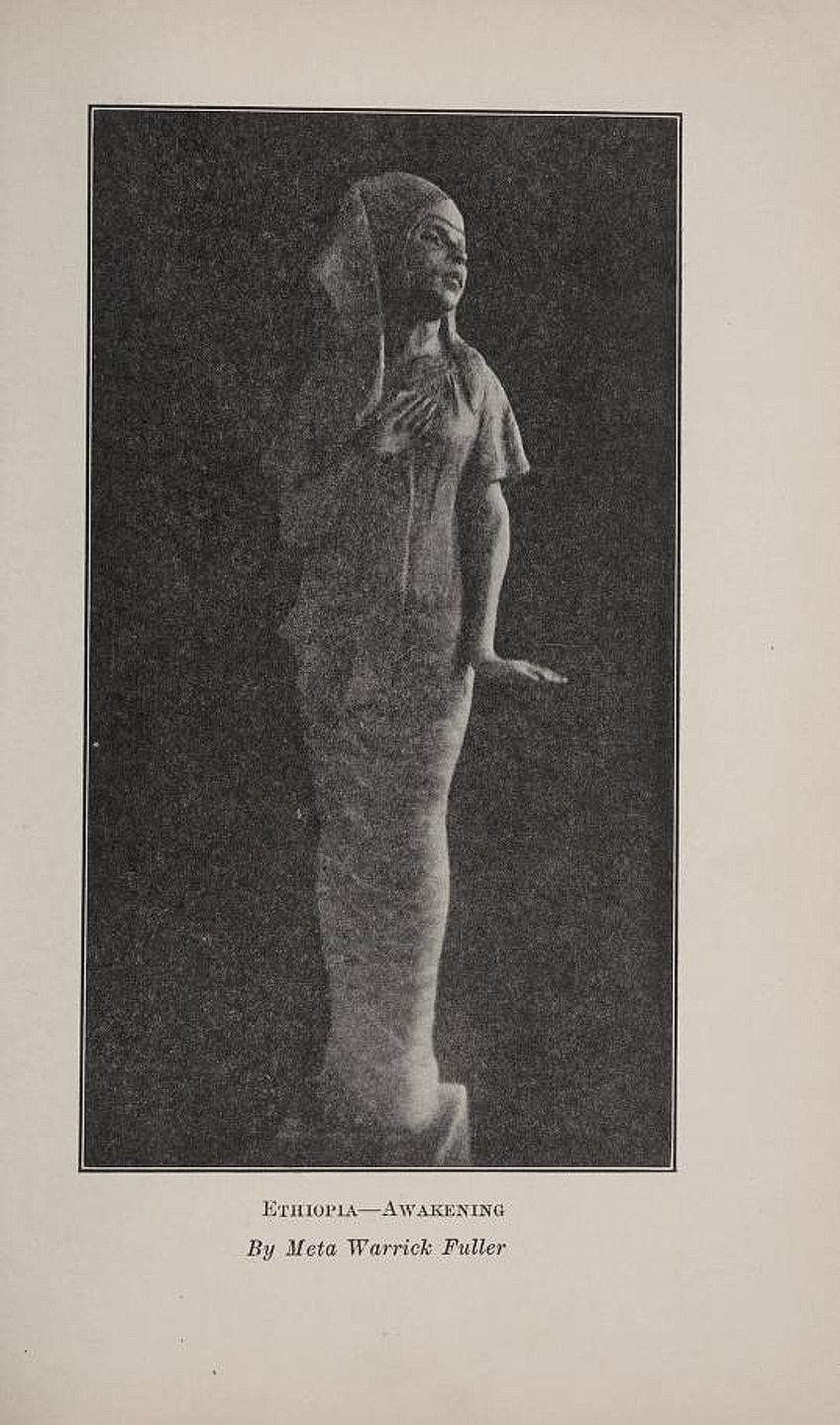 Photograph of a modest maquette of Ethiopia Awakening by Meta Warrick Fuller, c. 1921; Photographer not credited. Published in Robert T. Kerlin, Negro Poets and their Poems (Washington, DC: Associated Publishers, Inc., 1923)., Public domain, via Wikimedia Commons
The African American Legacy
The Harlem Renaissance reached its endpoint between the 1930s and 1940s. While it may have ended as a motion, information technology certainly lived on in many second-generation artists. Information technology also paved the way for many female person artists to express their unique gifts and abilities. People like Augusta Cruel inspired and led the way for what women are now able to do.
In fact, it was not only women that were inspired, but likewise whatsoever communities that had faced generations of oppression. They were given an outlet to express their skills and talents, whether information technology was sculpture, painting, photography, writing, making music, or interim in theater.
The Harlem Renaissance period besides adult new philosophical ideals like Négritude, which was a new cultural movement started by the French Aimé Césaire, Leon Damas, and Léopold Senghor. They as well influenced other philosophers like Jean-Paul Sartre, who was an important figure in French philosophical thought likewise as Marxism.
Harlem Renaissance artwork contributed to the growth and evolution of African American art for decades to come up. It influenced artists of all walks of life and backgrounds to create, produce, and express the heritage, traumas, and unique abilities within them. This motion grew beyond Harlem and inspired those on the fringes of lodge to come forrad and unashamedly evidence the globe who they were.
Frequently Asked Questions
When Was the Harlem Renaissance?
The Harlem Renaissance started during the late 1910s and early on 1920s in New York City, around the end of Earth War I, and lasted until the 1940s, around World War II. In that location are other sources that study its ending date around 1929, during the time of the Stock Market place Crash that led to the Corking Depression in 1930, which led many people to lose their livelihoods.
How Did the Harlem Renaissance Showtime?
The Harlem Renaissance's origins lie in the events before the Bang-up Migration, which is dated to around 1916 in Southern America. Due to slavery, lynching, and societal, cultural, and racial oppression, millions of blackness Americans migrated from places similar Mississippi, South Carolina, and Louisiana to Northern American cities like New York, Los Angeles, and Washington D.C (among others), where they had better handling and more opportunities.
What Was the Harlem Renaissance?
The Harlem Renaissance was a revival of cultural trends in the Harlem neighborhood of New York City. It was primarily a community of African American artists who questioned the oppression felt from racism, slavery, and racial injustices, inequalities, and stereotypical perspectives from problems like white supremacism.
What Was Harlem Renaissance Fine art?
The cultural awakening in Harlem, called the Harlem Renaissance, was expressed through the visual arts. There were artists from a variety of disciplines similar theater and pic, literature, and music like Jazz. Visual arts included paintings, sculptures, printmaking, and illustrations.
What Were the Characteristics of Harlem Renaissance Fine art?
There was a diverse group of people inside the Harlem customs, merely some of the main characteristics were inspired by the modernist art movements that incorporated more abstractions and figurative portrayals of compositions. In that location was besides an influence from African art, for case, African masks and motifs. Overall, the primary characteristics of Harlem Renaissance Art were cocky-expression and breaking the boundaries between prejudice and identity.
What Did Harlem Renaissance Artists Limited Through Sculpture?
Harlem Renaissance artists used sculpture to limited the inherent ideals of the Harlem Renaissance, which were to express their solidarity and uniqueness every bit a customs and an African American civilization. They also used sculpture to illustrate and embody their skills and widely learned skills, as well as the everyday lifestyles and occurrences of people.
Source: https://artincontext.org/harlem-renaissance-art/
0 Response to "What Type of Art Was Developed During the Harlem Renaissance"
Post a Comment