Read the Curse of the Pharoahs Online Free
Every bit I have written before on this blog, the Ancient Egyptians had many beliefs almost decease and the afterlife, and upon the pharaoh'southward death they followed detailed rituals to ensure he or she would live on eternally. Crucial in the rituals was mummification of the pharaoh'due south remains followed by entombment, to ensure that the pharaoh and his/her possessions would be protected past the god of death, Anubis (pictured above).
The thought of all this was that the tomb would remain sealed. For good. Information technology was admittedly not a pharaoh's desire that the tomb exist opened 1 day and plundered by a robber – or, thousands of years later, by an eager Egyptologist.
Egyptology was all the rage in the 1800s and early 1900s. People with means from Europe flocked to Egypt for the thrill of solving ancient mysteries and uncovering nifty treasures – challenge treasures, even. Taking them from Arab republic of egypt. Profiting from them.
Meanwhile, upon learning of the discoveries made in Egypt, some imaginative writers had begun dreaming up stories in which mummies were horrifying undead creatures who would seek revenge for their tombs having been disturbed. Louisa May Alcott is one such writer: famous these days for her Little Women series of books, she also published sensationalist short stories under a pen name, A.M. Barnard, and in 1869 she published 'Lost in a Pyramid, or The Mummy's Curse'.
By the time Howard Carter opened the tomb of Tutankhamun in 1922, a rumour was circulating: that it was a dangerous concern indeed to disturb the tombs of the ancient kings. Curses had been institute inscribed outside sealed tombs, threatening whatever who entered everything from a life without pleasure to the destruction of the soul.
The local men working with Howard Carter were deeply superstitious and were terrified to open up the tomb, and Carter and his squad did nothing to reassure them, knowing that the men'southward fear would keep them from exploring the tomb lonely at nighttime, when the excavations were paused. The dig continued, and such amazing treasures were unearthed… forth with what would become the well-nigh famous mummy in history.

Howard Carter examining the sarcophagus of Tutankhamun
Then Lord Carnarvon, funder of the Tutankhamun dig, died from blood poisoning later on a musquito bite, and Sir Arthur Conan Doyle (creator of Sherlock Holmes) declared that Carnarvon'due south decease was at the hands of what he called 'elementals' that guarded the tomb of King Tut… and the residuum, as they say, is history. The press whipped upwardly a sensationalist news story of disaster befalling all who disturbed the regal tombs, which was inaccurate but made Egyptology all the more heady.
Howard Carter himself dismissed the curse every bit nonsense, saying that 'the sentiment of the Egyptologist… is not one of fearfulness, but of respect and awe… entirely opposed to foolish superstitions'.
'Respect and awe' with regard to Egyptian antiquities: this is a thread that runs through my novel Song of the Nile. In the volume, Phares and Aida hash out the idea of the curse of the pharaohs while visiting the Temple of Philae.
Phares drew her attending back to the ruins of Philae. 'These immense buildings take a certain solemn grandeur, don't they?'
Aida nodded pensively. 'When we walked through the Temple of Isis, I couldn't help simply feel that tramping these sacred places is somehow profane,' she murmured. She glanced at the alpine palms, their heavy branches seeming to bend over the ruins as though they were weeping, and gave a trivial shiver. 'Do you believe in the expletive of the Pharaohs? Do you think that in agonizing the tombs of the ancients, they signed their own death warrant, or that the strange number of deaths were caused by the release of bacterial spores, or whatever scientists at present remember?'
Phares shrugged. 'My father believes that Egyptian curses are a production of our superstitious civilization and their psychological affect can be powerful. When y'all look at those curses, they were designed to strike terror into the hearts of tomb robbers. For example, there are some tombs where the Pharaoh has inscribed a curse, like the one etched in the tomb of Khentika Ikhekhi, which reads something like: "Who ever shall enter my tomb volition exist judged … an cease shall be made for him … I shall seize his neck like a bird … I shall cast the fear of myself into him." I can't remember the exact wording.' He turned to Aida and smiled, catching agree of her paw. 'Exercise you think we'll be cursed for coming here, is that it, chérie?'
She laughed and shook her head, thinking of the Victorians and their plundering of the sacred tombs and temples of the island. Her English forebears perhaps deserved a curse or 2 to autumn on their heads, she thought wryly.
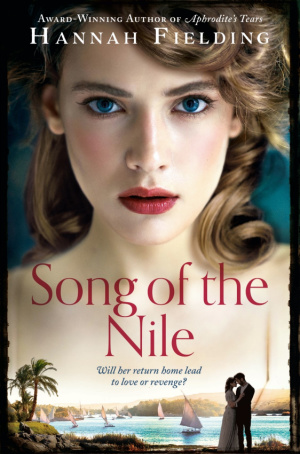
Vocal of the Nile: available to buy now
To this day the treatment of Ancient Egyptian antiquities is a topic that is hotly debated. Around the world at that place are collections of artefacts that were taken from Egypt at the height of Egyptomania without the permission of the government. Should these be returned to Egypt? What of excavations: Is information technology sacrilegious to disturb an ancient tomb? Is it acceptable for tourists to visit tombs? And how about museums, should they collect and brandish mummies?
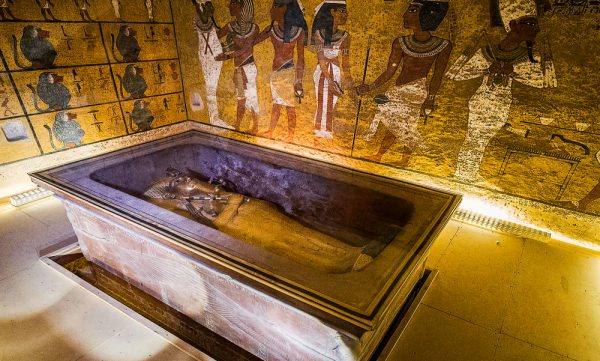
Tutankhamun on display
Whatever your opinion, it is clear that any arroyo to antiquities should be based on the tenets of respect and awe. In this mode, nosotros can honour the pharaohs.
And how they would have loved to be honoured! I doubt that the ancient pharaohs dreamed of being examined and displayed in museums thousands of years later on their death, simply they did dream of eternal life, of always existence known and revered. In a sense, then, the discoveries of the past 200 years have enacted the magic of the death rituals: the pharaohs volition live eternally.
Photo credits: one) Vladimir Melnik/Shutterstock.com; 2) New York Times/Wikipedia.
Source: https://hannahfielding.net/curse-pharaohs/
0 Response to "Read the Curse of the Pharoahs Online Free"
Post a Comment